• Skip to main content
  • Skip to secondary menu
  • Skip to footer

Travel Marketing

Travel and Tourism Trends

  • Sponsored Post
  • Travel Event Calendar
  • Travel Market
  • Travel Magazine
  • About
  • Contact

Haifa, Where Stone Turns Soft Under Mediterranean Light

March 1, 2026 By admin Leave a Comment

This image settles into you slowly, the way Haifa itself does if you give it half a chance. The mosque rises from honey-colored stone with that unmistakable green dome catching the sun, not shouting for attention, just holding it. The minaret is slender and calm, stacked with pale blocks that feel worn in the good way, like they’ve been warmed by decades of hands and weather. You can almost trace the texture with your eyes, every joint between stones visible, every window arched with a patience that modern buildings never quite manage. The sky is a deep, unapologetic blue, the kind Haifa gets on clear days when the sea breeze has swept everything clean. On the right edge, a tree leans into the frame, its sparse leaves half-gold, half-dusty green, as if unsure whether it’s still summer or already thinking about autumn. Down below, life gathers close to the walls: people sitting, talking, waiting, the street bending gently as it disappears, a few signs and poles reminding you this is not a museum scene but a living city that keeps moving even when it looks still.
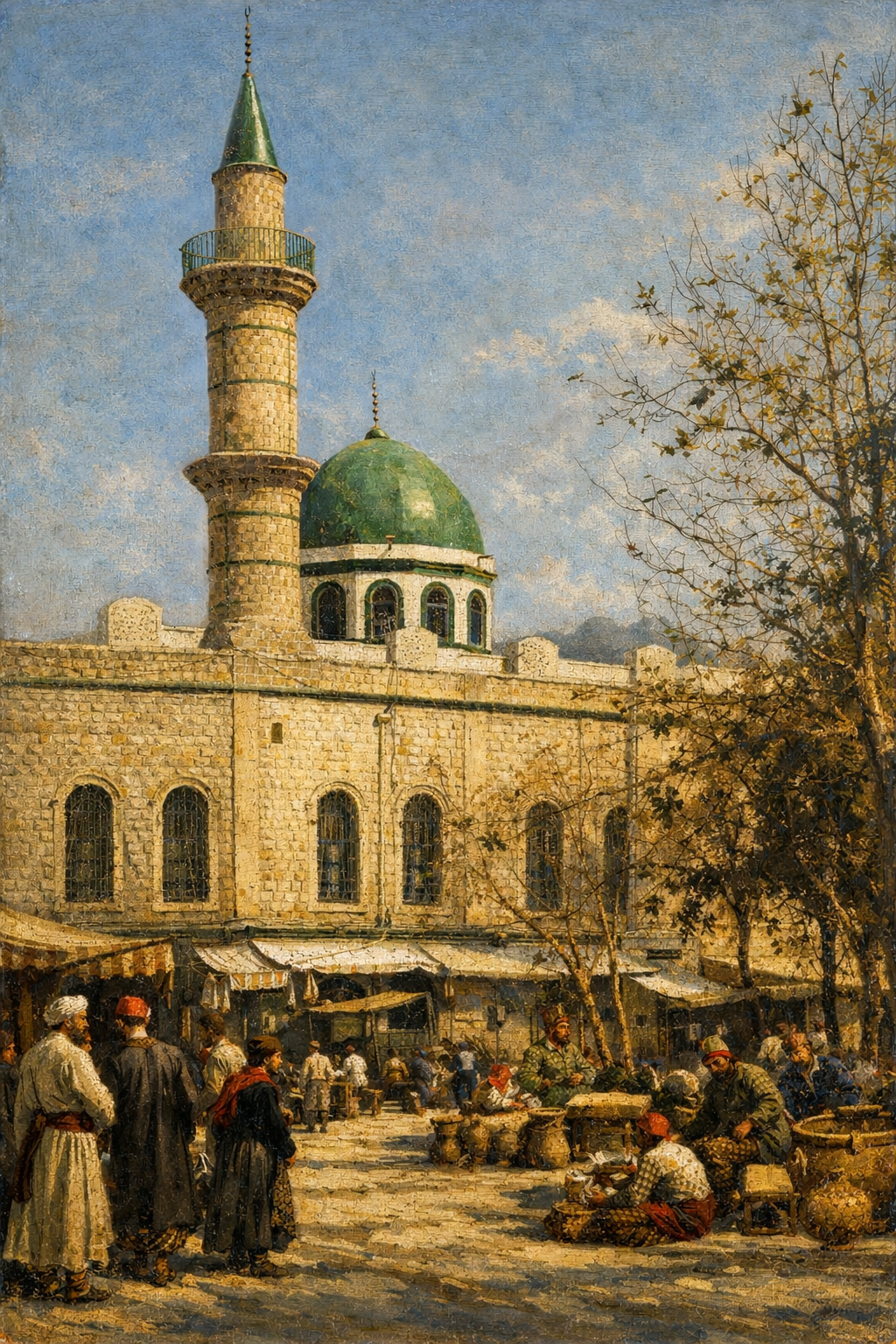
Haifa, Where Stone Turns Soft Under Mediterranean Light

This is Haifa at street level, far from the postcard angles of the terraces and the panoramic lookouts. Neighborhoods like Wadi Nisnas carry this layered feeling where Arab, Jewish, Ottoman, British, and modern Israeli timelines overlap without asking permission. The mosque, likely familiar to locals who pass it daily without lifting their phones, becomes a quiet anchor rather than a spectacle. Markets hum nearby, cafés spill chairs onto sidewalks, conversations switch languages mid-sentence, and nobody seems bothered by the mix because the mix is the point. Haifa doesn’t perform coexistence; it practices it, imperfectly, casually, sometimes stubbornly, but always in plain sight. Standing here, you sense how the city slopes from Mount Carmel down toward the Mediterranean, how gravity and history both pull things together.

Traveling in Haifa often means slowing your pace without planning to. You arrive thinking you’ll check off a few sights, and suddenly you’re lingering, watching light slide across stone façades, listening to the echo of footsteps, noticing how green domes, tiled roofs, and pale limestone coexist without clashing. This scene captures that balance better than any skyline shot ever could. It’s a reminder that Haifa’s real charm lives in these ordinary moments: a bend in the road, a sacred building woven into daily routines, a patch of shade offered by a tree that’s seen it all before. You don’t rush through places like this. You let them sit with you, and somehow, they do.

Filed Under: News

Reader Interactions

Leave a Reply Cancel reply

Your email address will not be published. Required fields are marked *

Footer

Recent Posts

  • Taormina Beach Guide: Mazzarò, Isola Bella, and What Nobody Tells You About the Pebbles
  • Juliet’s Balcony in Verona Was Added in the 1930s and the Crowds Do Not Care
  • St Mark’s Basilica in Venice: The Gold Mosaics Are Dimmer Than the Photographs Suggest
  • China Fines Trip.com $770 Million for Locking Hotels Into Exclusive Deals
  • Château de Monbazillac, Dordogne: A difficult childhood. One château too many.
  • Fora Hits $1 Billion Valuation as AI Transforms the Future of Travel Planning
  • The Open Kitchen Experience: Dining Where You Can Watch the Cooking
  • Holland America Line Adds Flåm and Hellesylt to Five 2027 Norway Fjord Cruises
  • La Cité du Vin, Bordeaux: The Building That Looks Like Wine in a Glass
  • EU Border Delays: ETIAS Pre-Travel Authorization Pushed to Late 2026 as EES Chaos Continues

Media Partners

  • Virtual Travel Guide
  • Ancient Rome
The 18th-Century Fountain Hidden Inside Bordeaux’s Customs Museum Courtyard
The Bilbao Effect, 500 Years Early: Jerónimos Monastery And The Guggenheim
Bilbao’s Quiet Renaissance: From Industrial Port to Design Destination
Lisbon’s Seven Hills: A Walking Guide That Tells You the Truth
New Orleans: An American City That Plays by Different Rules
Ha Long Bay Without the Cruise Brochure
Istanbul at the Threshold: A City That Has Always Been Two Things at Once
Iceland’s Ring Road: What the Drive Teaches You That No Photograph Can
Marrakech’s Medina: How to Read a City That Was Not Designed for You
Torres del Paine: What You Are Actually Getting Into
Sponsored Post
About
Contact
Aquincum Museum Reconstructs 16 Roman Faces From Skulls Found on Budapest's Danube Frontier
Roman Public Latrines Reveal an Empire That Built Sanitation Without Achieving Hygiene
The Pont du Gard: Rome's Most Perfect Structure
Water Across the Empire: Roman Aqueducts and the Hydraulic Logic of Conquest
Who Cleaned Roman Rome: The Social Economy of Waste
The Oath of the Horatii: David's Roman Republic in Paint
Spartacus (2010–2013): The Show That Earned Its Excess

Media Partners

The Immersive Experience in the Museum World
Japan, China, and Taiwan: A New Triangle of Risk — and a Window of Opportunity for Japan
Ghost Kitchens as Infrastructure: The Shift from Restaurants to Intelligent Food Networks
The Zoom Divide Nobody Saw Coming
The Perfect Budget Content-Creator Kit
Reimagining Prague’s Tourism Future Through Immersive Media and VR Museums
Israel’s Urban Paradox: Tel Aviv Moves, the Rest Stand Still
American Express Global Business Travel (GBTG): Understanding the Business and the Investment Case
Why the Canon R8 Paired With the New RF 45mm f/1.2 Lens Quietly Becomes the Content Creator’s Sweet-Spot
The Future of Travel: A $15.5 Trillion Industry

Copyright © 2026 Travel Marketing

Media Partners: Timey · Publishing House · Ancient Rome · Photography · Calendarial · Transportational