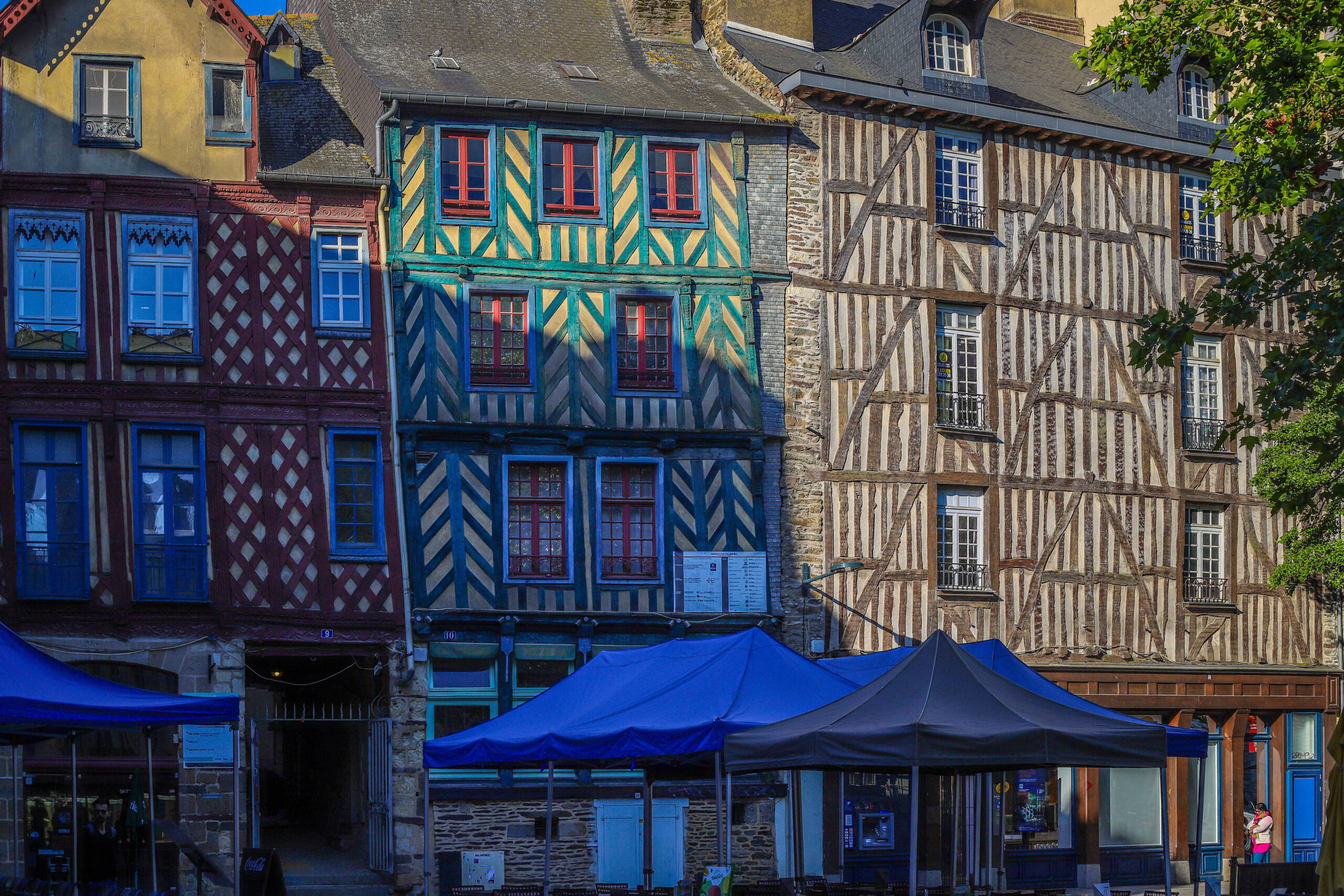
This is one of the more theatrical corners of Rennes’ old town — a run of half-timbered façades in green, mustard, deep maroon, and blue, each one tilting slightly off true, the way centuries of wood does when there’s no stone wall holding it straight.
Rennes has one of France’s largest surviving collections of these houses — roughly 286 painted timber-framed medieval buildings, second in the country only to Strasbourg. Most went up between the 15th and 17th centuries, when Brittany’s Parlement drew lawyers, judges, and newly wealthy officials into the city and they built accordingly — tall, narrow, richly timbered townhouses stacked shoulder to shoulder along the medieval street grid.
The leaning isn’t decay so much as structural honesty. Without stone party walls to separate the buildings, the timber frames warped over time — a shifting suppleness typical of wood construction. Later renovations made it worse in places: owners cut extra windows into the façades for more light, which left the houses without enough support and skewed them further, not that it hurts the effect any.
A good chunk of this heritage survives by accident of geography. A catastrophic fire tore through Rennes in 1720, but Brittany’s capital still held on to more half-timbering than anywhere else in the region. The diamond and chevron lattice patterns on display here — the crisscrossing braces filled in with color — were the standard decorative vocabulary of the period, and this stretch shows several variations side by side: a lattice-diamond frontage in oxblood and cream on the left, chevron stripes in teal and ochre in the center, and the plainer vertical-and-diagonal bracing of an older stone-and-timber hybrid on the right.
Streets like Rue Saint-Georges, Rue Saint-Michel, and the Place du Champ-Jacquet are the classic places to see this style clustered together, usually with a market or café tucked underneath — much like the market tents doing exactly that job in this frame.