The photo captures that unmistakable moment of discovery when the city unfolds in front of you from the top deck of a sightseeing bus. The air is warm, people are leaning forward with their earbuds in, and every pair of eyes is drawn toward the neoclassical grandeur at the end of the street: the Panthéon. Its domed silhouette rises above the rooftops like a crown, the colonnaded façade dignified and symmetrical, commanding the square with a calm authority. The building’s pale stone gleams softly in the daylight, a reminder of its origins as a church and its eventual transformation into a mausoleum for France’s most revered citizens.
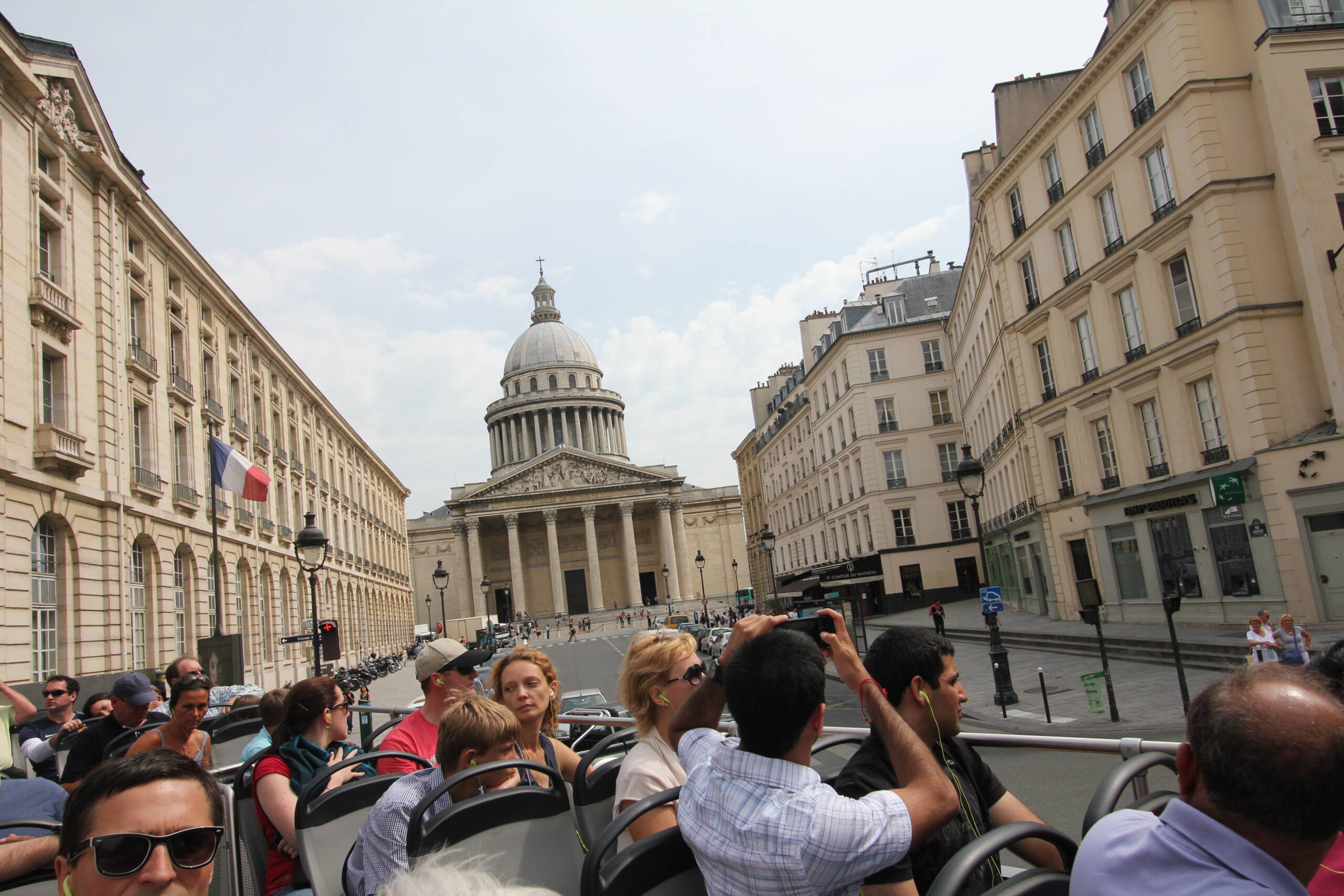
The perspective is striking. On either side, rows of Parisian townhouses stretch out in creamy stone, their wrought-iron balconies repeating like rhythmic notes along the façades. The French flag ripples lightly from a government building on the left, reminding you of the civic pride woven into this quarter of the city. Meanwhile, the streets below are unexpectedly calm, a few pedestrians strolling lazily, shopfronts closed, as though the city itself had stepped aside to let you focus on the monument ahead.
There’s something charming in the passengers’ reactions—some snapping photos, others leaning into conversation, a few lost in their own thoughts. It mirrors the experience of travel itself: a mixture of quiet absorption and shared excitement. From this angle, the Panthéon doesn’t just dominate the skyline; it feels like the very climax of the ride, the point toward which the journey has been quietly building.
The Panthéon of Paris is one of those monuments that tells the story of France not just through its architecture, but through the lives it shelters. Built between 1758 and 1790 under the orders of King Louis XV, it was originally designed as a church dedicated to Sainte Geneviève, the patron saint of Paris. Architect Jacques-Germain Soufflot aimed to merge classical elegance with the airy lightness of Gothic construction, and the result is breathtaking: a colonnaded portico, a sculpted pediment alive with allegory, and a massive dome that anchors the Left Bank skyline.
The French Revolution changed its fate. Before the church was ever consecrated, the revolutionary government decided it should serve as a mausoleum for the nation’s greatest citizens. It became a temple of memory where writers, philosophers, scientists, and statesmen would rest. Voltaire and Rousseau, who shaped the Enlightenment, are here; Victor Hugo, whose words carried France into a new literary age, rests beneath the same roof; Émile Zola and Alexandre Dumas join them, along with Simone Veil, whose life embodied resilience and justice. Among them lies Marie Curie, the first woman honored for her own achievements, a reminder that the Panthéon is not just a monument to the past but also a mirror of progress.
Science, too, found its place here. In 1851, Léon Foucault hung his famous pendulum beneath the dome to demonstrate the Earth’s rotation. That simple, graceful swing turned the building into a laboratory of the cosmos, binding the heavens to the stones of Paris.
From the bus, it is easy to be dazzled only by the grand façade, but stepping inside reveals something deeper: a space where faith, reason, art, and politics converge. The Panthéon is at once a church without masses and a civic temple without gods, a monument to the endurance of human achievement. To pass in front of it, as our bus did, is to be reminded that Paris does not merely show its landmarks—it shares its history, its struggles, and its ideals with every visitor who stops to look a little longer.