• Skip to main content
  • Skip to secondary menu
  • Skip to footer

Travel Marketing

Travel and Tourism Trends

  • Sponsored Post
  • Travel Event Calendar
  • Travel Market
  • Travel Magazine
  • About
  • Contact

Palermo, Sicily: A Journey Through History, Flavor, and Street Life

September 23, 2025 By admin Leave a Comment

Palermo isn’t a city you visit quietly. It rushes at you in sound, scent, and color, demanding that you pay attention. Walking through its historic heart, the Palermo Cathedral rises in a patchwork of styles—Norman, Arabic, Byzantine—its rooftop offering sweeping views over domes, terracotta rooftops, and the Mediterranean beyond. Just nearby, the Norman Palace and its Palatine Chapel glow with golden mosaics that seem to trap the light and history of empires in every fragment of glass.

The city breathes in its markets. Ballarò, Capo, and Vucciria are a chaos of voices, sizzling pans, and aromas that tumble into one another—fried panelle, fresh sardines, pyramids of oranges, arancini that burn your fingertips with their first bite. Here, travel is not about seeing but tasting, smelling, and stumbling into life as it happens. Even the city squares tell stories: the theatrical Quattro Canti, the dramatic Pretorian Fountain with its half-scandalous marble figures, the unexpected stillness of Villa Bonnano Gardens where orange blossoms sweeten the air.
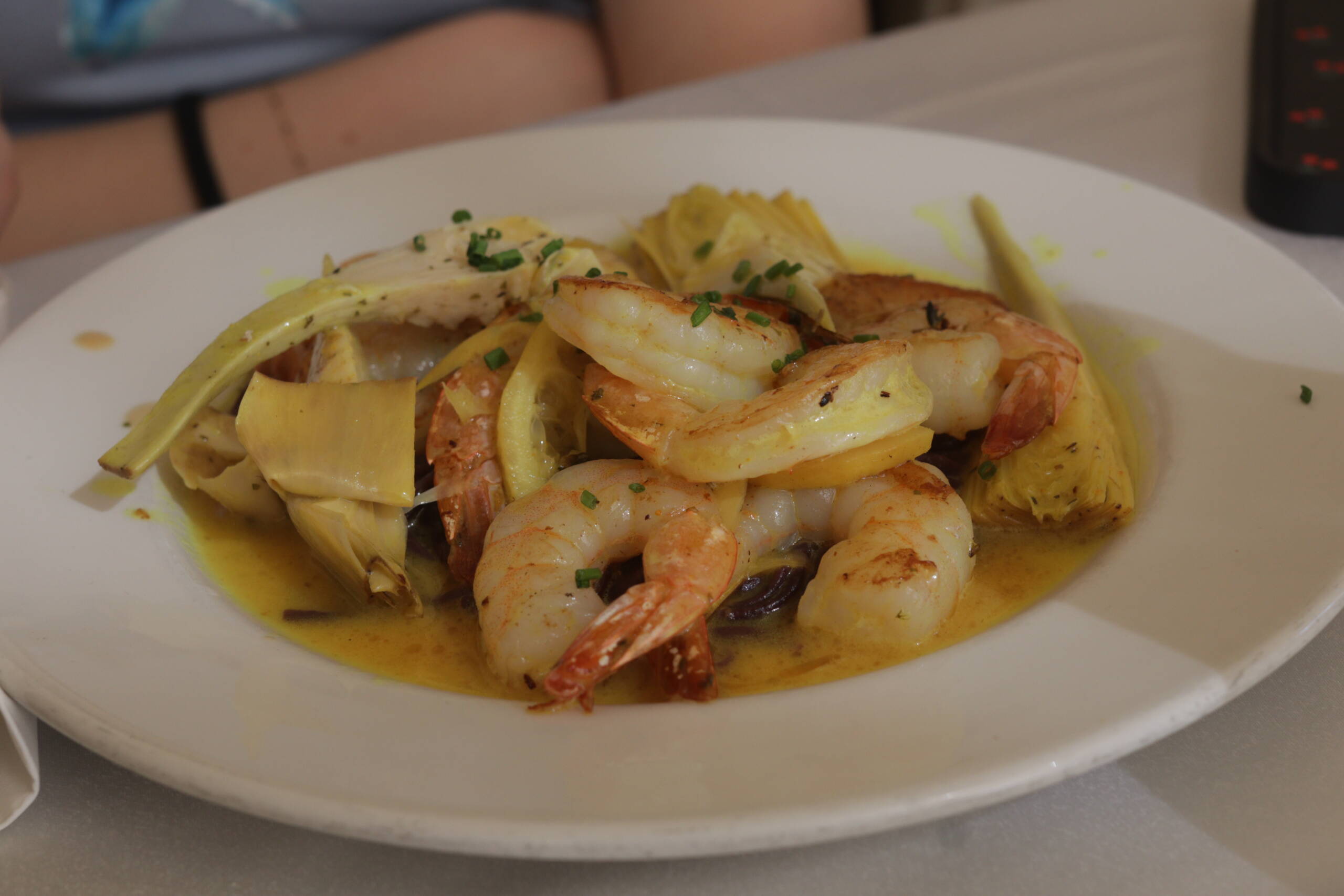
Palermo on a plate

A plate like this feels almost like Palermo distilled onto porcelain—bright, bold, and unapologetically Mediterranean. The shrimp, plump and glistening, taste of the sea that defines the city’s rhythm. They sit tangled with lemon slices, giving off that sharp citrus fragrance that seems to hang in Palermo’s air, where orange trees line the boulevards and fruit markets overflow with color. The artichokes, tender and earthy, recall the countryside just outside the city, where fertile Sicilian soil feeds both tradition and creativity. A drizzle of golden sauce pools at the bottom, somewhere between broth and silk, echoing the city’s way of turning the simplest ingredients into something celebratory.

Eating a dish like this in Palermo would not just be about food—it would be about context. Imagine savoring it after a morning wandering through Ballarò market, ears full of the calls of vendors, or after an afternoon tracing mosaics in the Palatine Chapel. The shrimp would not just be shrimp, but a conversation with the fishermen at Vucciria, the artichokes not just vegetables but a link to the patchwork of fields and gardens that still sustain the city. A meal here is a continuation of Palermo’s story: centuries of trade, conquest, and coexistence brought to the table in flavors both humble and regal.

This dish isn’t just lunch—it’s Palermo on a plate. A reminder that the city feeds not only your body but your imagination, that each bite is as much history as it is nourishment.

Palermo also speaks of resistance. Walking tours that trace the city’s “No Mafia” history reveal another layer of identity—stories of courage and transformation etched into daily life. To change pace, climb Monte Pellegrino, where the city spreads beneath you like a mosaic, or visit Palazzo Chiaramonte-Steri, whose ceilings whisper of art and inquisition alike. And when evening falls, the Teatro Massimo calls—whether for an opera or simply to marvel at the grandeur of a building that embodies Palermo’s cultural spirit.

If time allows, the treasures spill beyond the city. Monreale’s cathedral gleams in mosaics that rival Byzantium itself, while Mondello beach offers sand, sea, and Sicilian sunlight for those who crave a slower rhythm. And everywhere—always—there is food. Cannoli filled with sweet ricotta, slices of sfincione, cooling granita under the midday sun. Palermo’s cuisine is the truest guidebook, a blend of all the cultures that have left their mark on the city.

Palermo isn’t just a destination; it’s a collision of history, chaos, and flavor that will linger long after you leave. It’s not the neatest city, nor the quietest, but perhaps that’s the point: it makes you feel alive.

Filed Under: News

Reader Interactions

Leave a Reply Cancel reply

Your email address will not be published. Required fields are marked *

Footer

Recent Posts

  • Why Lisbon Cafés Are Putting Up No Laptops Signs: Coffee, Instagram, and the Remote Work Terrace
  • Four in Ten Travelers Visit Landmarks Mainly for the Photo: How Instagram and Reels Reshaped Tourism
  • Why Comporta Still Feels Empty: The Rice Estate Behind Portugal’s Most Coveted Beaches
  • Travel in 2026: Five Photos That Explain the Year’s Real Trends
  • Tiny Tourism: Why Travellers Are Choosing Towns Nobody Photographs
  • In Defence of the Hop-On Hop-Off Bus
  • EasyJet Agrees £5.7bn Apollo Takeover: What Changes for Passengers and What Doesn’t
  • Taormina Beach Guide: Mazzarò, Isola Bella, and What Nobody Tells You About the Pebbles
  • Juliet’s Balcony in Verona Was Added in the 1930s and the Crowds Do Not Care
  • St Mark’s Basilica in Venice: The Gold Mosaics Are Dimmer Than the Photographs Suggest

Media Partners

  • Virtual Travel Guide
  • Ancient Rome
Sintra at Noon, Venice at Midnight: Six European Cities and the Hour That Suits Them
Porto’s Chestnut Season Is the Shoulder Season Worth Booking
Venice at Night Is the Version No Access Fee Covers
The 18th-Century Fountain Hidden Inside Bordeaux’s Customs Museum Courtyard
The Bilbao Effect, 500 Years Early: Jerónimos Monastery And The Guggenheim
Bilbao’s Quiet Renaissance: From Industrial Port to Design Destination
Lisbon’s Seven Hills: A Walking Guide That Tells You the Truth
New Orleans: An American City That Plays by Different Rules
Ha Long Bay Without the Cruise Brochure
Istanbul at the Threshold: A City That Has Always Been Two Things at Once
Sponsored Post
About
Contact
Roman Concrete in Museum Fragments: What the Cross-Section Actually Shows
Roman Sarcophagi Spent More Time as Fountains and Church Tombs Than as Graves
Aquincum Museum Reconstructs 16 Roman Faces From Skulls Found on Budapest's Danube Frontier
Roman Public Latrines Reveal an Empire That Built Sanitation Without Achieving Hygiene
The Pont du Gard: Rome's Most Perfect Structure
Water Across the Empire: Roman Aqueducts and the Hydraulic Logic of Conquest
Who Cleaned Roman Rome: The Social Economy of Waste

Media Partners

  • Media Forum
  • Market Analysis
SanDisk (SNDK) Rallied 11.9% Into an S&P 100 Add That Forces Almost Nobody to Buy
Texas A&M Is Spending $11.8 Million on a Water Tower Before Its Semiconductor Institute Can Open
Cloudflare's September 15 AI Crawler Block Turns the Ad Tag Into an Access Key
Pedro Sánchez Lost Control at Ceuta and Blamed Everyone Else
Three European Cities Where Architecture and Festival Collide
Duane Davis Convicted in Tupac Shakur's 1996 Murder
AI Content Licensing in 2026: Who Is Actually Getting Paid, and Who Never Will
Google AI Overviews and the Publisher Traffic Collapse: What the 2026 Numbers Actually Show
NBCUniversal Puts Peacock Inside YouTube Premium, and Concedes Where the Audience Already Lives
Nexstar Owns Tegna and Isn't Allowed to Run It: Inside the Hold-Separate Order
The Immersive Experience in the Museum World
Japan, China, and Taiwan: A New Triangle of Risk — and a Window of Opportunity for Japan
Ghost Kitchens as Infrastructure: The Shift from Restaurants to Intelligent Food Networks
The Zoom Divide Nobody Saw Coming
The Perfect Budget Content-Creator Kit
Reimagining Prague’s Tourism Future Through Immersive Media and VR Museums
Israel’s Urban Paradox: Tel Aviv Moves, the Rest Stand Still
American Express Global Business Travel (GBTG): Understanding the Business and the Investment Case
Why the Canon R8 Paired With the New RF 45mm f/1.2 Lens Quietly Becomes the Content Creator’s Sweet-Spot
The Future of Travel: A $15.5 Trillion Industry

Copyright © 2026 Travel Marketing

Media Partners: Timey · Publishing House · Ancient Rome · Photography · Calendarial · Transportational