• Skip to main content
  • Skip to secondary menu
  • Skip to footer

Travel Marketing

Travel and Tourism Trends

  • Sponsored Post
  • Travel Event Calendar
  • Travel Market
  • Travel Magazine
  • About
  • Contact

Bergerac, France — Where Time Moves a Little Softer

November 26, 2025 By admin

There’s something quietly magnetic about Bergerac. You don’t rush there, you *arrive*, and then the rhythm of the place does the rest. The Dordogne River flows past as if it has nowhere else to be, and somehow, after a few minutes, you feel the same. Walking through the medieval streets feels a bit like drifting through a painting—timbered houses leaning toward narrow cobbled lanes, cafés tucked under sun-washed shutters, and little statues of Cyrano de Bergerac watching over the squares with a sort of amused permanence.

One of the first pleasures is simply wandering. There’s no map needed, no goal—just that gentle kind of urban exploration where everything feels charming by accident. Every few steps there’s a small wine bar, a boulangerie sending out fresh brioche perfume, or a quiet square framed by stone façades that haven’t changed in centuries. Eventually you’ll reach the riverfront at Quai Cyrano, and here the whole scene opens up: sunlight dancing on the Dordogne, lazy boats drifting along the water, vineyards filling the horizon like a painted backdrop.

In the photo, a lively scene unfolds in the charming town of Bergerac, France. A group of elderly men and women are performing a traditional folk dance in a quaint cobblestone courtyard. They are dressed in period attire; the women wear long skirts, aprons, and blouses adorned with shawls, while the men don dark trousers, white shirts, and wide-brimmed hats. Their outfits reflect the rich cultural heritage of the region.
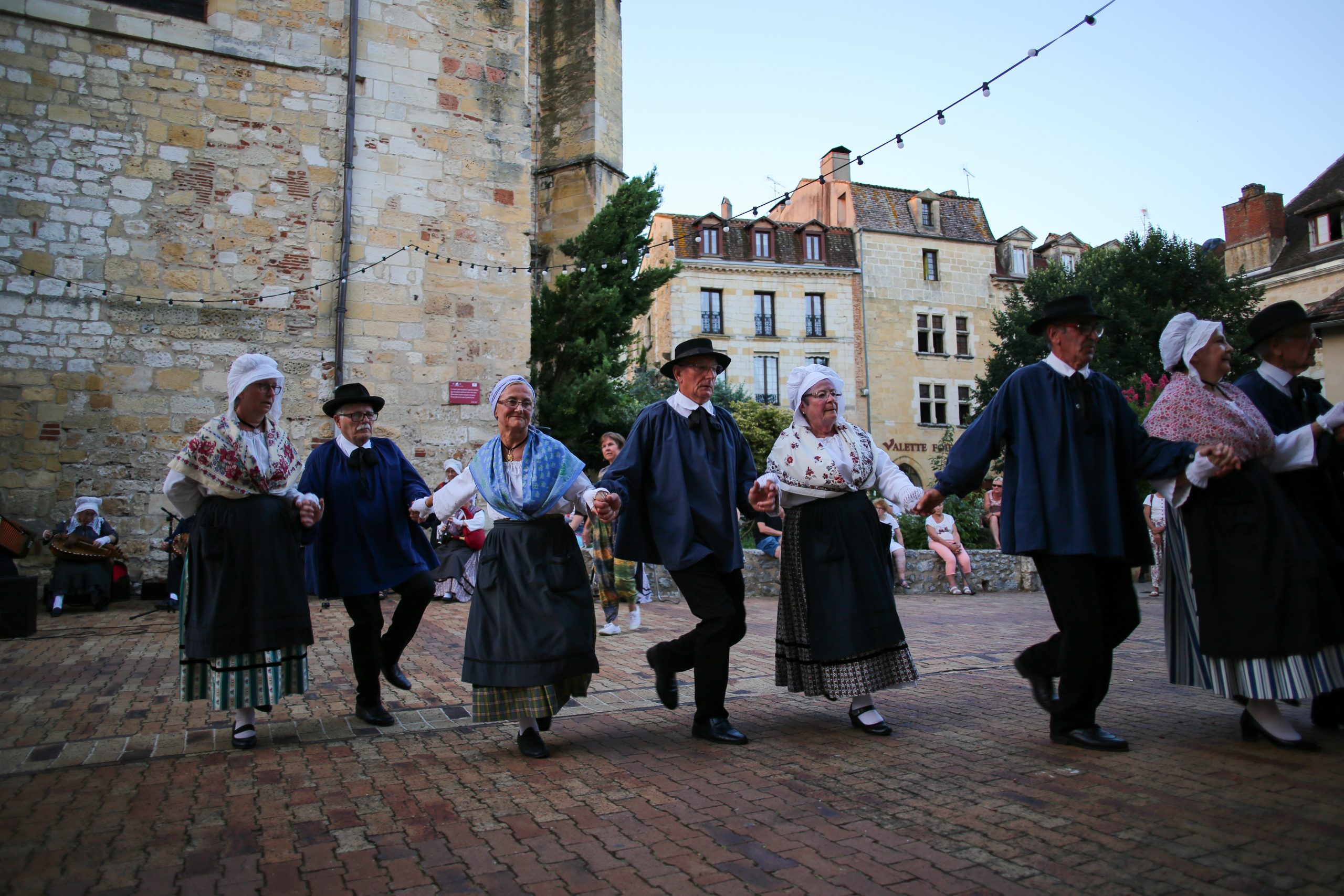
Folk Dances in Bergerac, France

The dancers hold hands in a circle, stepping in unison and smiling warmly, exuding a sense of joy and community. Behind them, the rustic stone walls of historic buildings create a picturesque backdrop, with the soft light of evening casting a warm glow over the scene. String lights hang overhead, adding a festive ambiance to the gathering. In the background, other townspeople and visitors sit on benches and steps, watching the performance and soaking in the traditional festivities. The entire image captures the essence of a close-knit community celebrating its heritage in a beautiful, timeless setting.

Wine tasting is almost a form of language here, and skipping it would feel wrong. The Maison des Vins, tucked inside an old cloister, makes it ridiculously easy to fall into the ritual. Glass in hand, you sit under medieval arches while someone explains Bergerac’s wine regions—not in a cold, snobbish way, but in that soft, proud tone that suggests the soil here means something deeper than agriculture. Reds, whites, rosés… the region doesn’t brag, but honestly, it could.

At some point, take a river cruise on a traditional gabarre. Sitting there while the Dordogne drifts under you feels almost meditative. The wind, the water, the quiet… if you’re the type who usually multitasks, this is where your brain will finally give up and let you exist in one moment at a time. And maybe that’s the real magic of the place—it slows the world down without asking permission.

Museums here have a quirky edge. The Tobacco Museum sounds odd at first (and it sort of is), but it’s woven into Bergerac’s agricultural history. You’ll walk through centuries of ritual, trade, and craftsmanship—pipes, snuffboxes, old trade documents—more fascinating than expected. And then there’s the Church of Notre-Dame, tall, calm, beautifully detailed, as if it exists purely to remind visitors how small the modern world really is.

If you linger longer, there are vineyards and sleepy villages nearby that make leaving town feel like stepping deeper into the same dream. Olive trees, sleepy farm roads, the occasional château… everything looks like a postcard someone forgot to edit because it was already perfect.

Truthfully, Bergerac isn’t loud, or flashy, or trying to compete with the big destinations that shout their grandeur. It whispers. And if you let it, that whisper turns into a feeling you quietly hope to return to someday.

Filed Under: News Tagged With: Bergerac, Folk Dances, France

Footer

Recent Posts

  • Royal Caribbean Buys 50% of Sandals Resorts for About $3 Billion, Bringing Cruises and All-Inclusives Together
  • TOURISE Summit 2027: March 23-25, Riyadh, Saudi Arabia
  • Wrocław’s Market Square in Fisheye: Why I Kept the Distortion
  • Salamanca’s Stone Faces: A Photo Essay in Five Frames
  • Europe’s Tourist Crime Belt: Pickpockets, Bracelet Scams, and Why the Same Offenders Keep Working
  • The Beach Racket in Italy, Greece and Spain: Turnstiles, Cheap Concessions, and a Shoreline You Can’t Reach
  • Why Lisbon Cafés Are Putting Up No Laptops Signs: Coffee, Instagram, and the Remote Work Terrace
  • Four in Ten Travelers Visit Landmarks Mainly for the Photo: How Instagram and Reels Reshaped Tourism
  • Why Comporta Still Feels Empty: The Rice Estate Behind Portugal’s Most Coveted Beaches
  • Travel in 2026: Five Photos That Explain the Year’s Real Trends

Media Partners

  • Virtual Travel Guide
  • Ancient Rome
  • Travel Magazine
Largo do Chiado at Night: A Brasileira, the Bronze Poet and a Floor Made of Waves
Sintra at Noon, Venice at Midnight: Six European Cities and the Hour That Suits Them
Porto’s Chestnut Season Is the Shoulder Season Worth Booking
Venice at Night Is the Version No Access Fee Covers
The 18th-Century Fountain Hidden Inside Bordeaux’s Customs Museum Courtyard
The Bilbao Effect, 500 Years Early: Jerónimos Monastery And The Guggenheim
Bilbao’s Quiet Renaissance: From Industrial Port to Design Destination
Lisbon’s Seven Hills: A Walking Guide That Tells You the Truth
New Orleans: An American City That Plays by Different Rules
Ha Long Bay Without the Cruise Brochure
Sponsored Post
About
Contact
Caligula: What the Sources Say About the Mad Emperor, and What They Invented
George Loring Brown's Temple of Peace Painting and the Roman Forum's Most Misnamed Ruin
Half of This Roman Mosaic Glass Bowl Is Plaster, and the Smithsonian Kept It
Julius Caesar's 44 BCE Denarius: The Coin That Helped Get Him Killed
Juno Moneta: How a Roman Goddess Gave Us the Words Money and Mint
Piranesi's Altar to Apollo and the 18th-Century Business of Selling Ancient Rome
A Freed Slave in Augustan Rome Paid to Have His Wrinkles Carved in Marble
Dolma in Baku: What to Order, How It's Served and Why UNESCO Lists It
Belém Tower Reopened in 2026: Timed Slots, a €15 Ticket and Whether to Go Inside
Big Buddha Temple on Koh Samui: The Naga Staircase, the Dress Code and When to Go
Burgos Cathedral: El Cid's Tomb, the Papamoscas and Free Tuesday Mornings
Caesarea Maritima: Herod's Harbour City, the Ticket and the Free Aqueduct Beach
Catania's Piazza del Duomo: The Lava Elephant, Sant'Agata and the Fish Market Next Door
Château de Fougères: 13 Towers, a Moat and Brittany's Border Fortress
La Cité du Vin in Bordeaux: What €23 Gets You, From the Exhibits to the Rooftop Glass
Haifa Cruise Port in 2026: A New Terminal, One Regular Ship and Which Lines Might Return
Hundertwasserhaus in Vienna: You Can't Go In, So Here's What to Do Instead

Media Partners

  • Travel Market
  • Timey.org
American Museum of Natural History: $37 for Out-of-State Adults and a $465 Million Gilder Center
EU Entry/Exit System Is Live at Every Border, and ETIAS Is Delayed Again With No Date
Hofbräuhaus Munich Pours a Litre for €11.60, About €4 Less Than an Oktoberfest Mass
Hundertwasserhaus Vienna: Free to Look At, Closed to Visitors, With a Paid Museum Five Minutes Away
Les Halles de Bacalan: Bordeaux's Food Hall Next to the Cité du Vin, With About 20 Stalls and No Mondays
Les Machines de l'île Nantes: €12 to Ride a 48-Tonne Elephant, With Rides Paused From November
The Met Charges Visitors $30, While New York State Residents Still Pay What They Wish
Munich Residenz Antiquarium: The Largest Renaissance Hall North of the Alps for a €10 Ticket
Musée des Confluences Lyon: A €255 Million Building, 700,000 Visitors a Year and a €12 Ticket
National Gallery London Stays Free After the UK Drops a Plan to Charge Foreign Visitors
Martian Moon eXplorer 2026, October 19, Yoshinobu Launch Complex LP-2, Tanegashima
Orbital Launch Schedule, Late September and October 2026, With Crew-13 and Starship Flight 14
Why Lisbon Left the Carmo Convent Roofless
Gauguin's Arearea: The Red Dog Paris Mocked in 1893 and the Painting He Bought Back
Plum Tart Is Coming, and These Are the Plums Going Into It
Bandinelli's Hercules and Cacus: It Looks Like a Forced Sexual Act Prelude
The Fencer of Wroclaw: A 1904 Fountain That Outlived the City That Commissioned It
Taobuk and the Infiorata: Two Kinds of Public Culture in One Taormina Square
The Padrão do Salado in Guimarães: Why Portugal's Birthplace Commemorates a Castilian Victory
Wawel Hill in Kraków: The Castle, the Bronze Model, and the Churches Drawn on the Grass

Copyright © 2026 Travel Marketing

Media Partners: Timey · Publishing House · Ancient Rome · Photography · Calendarial · Transportational