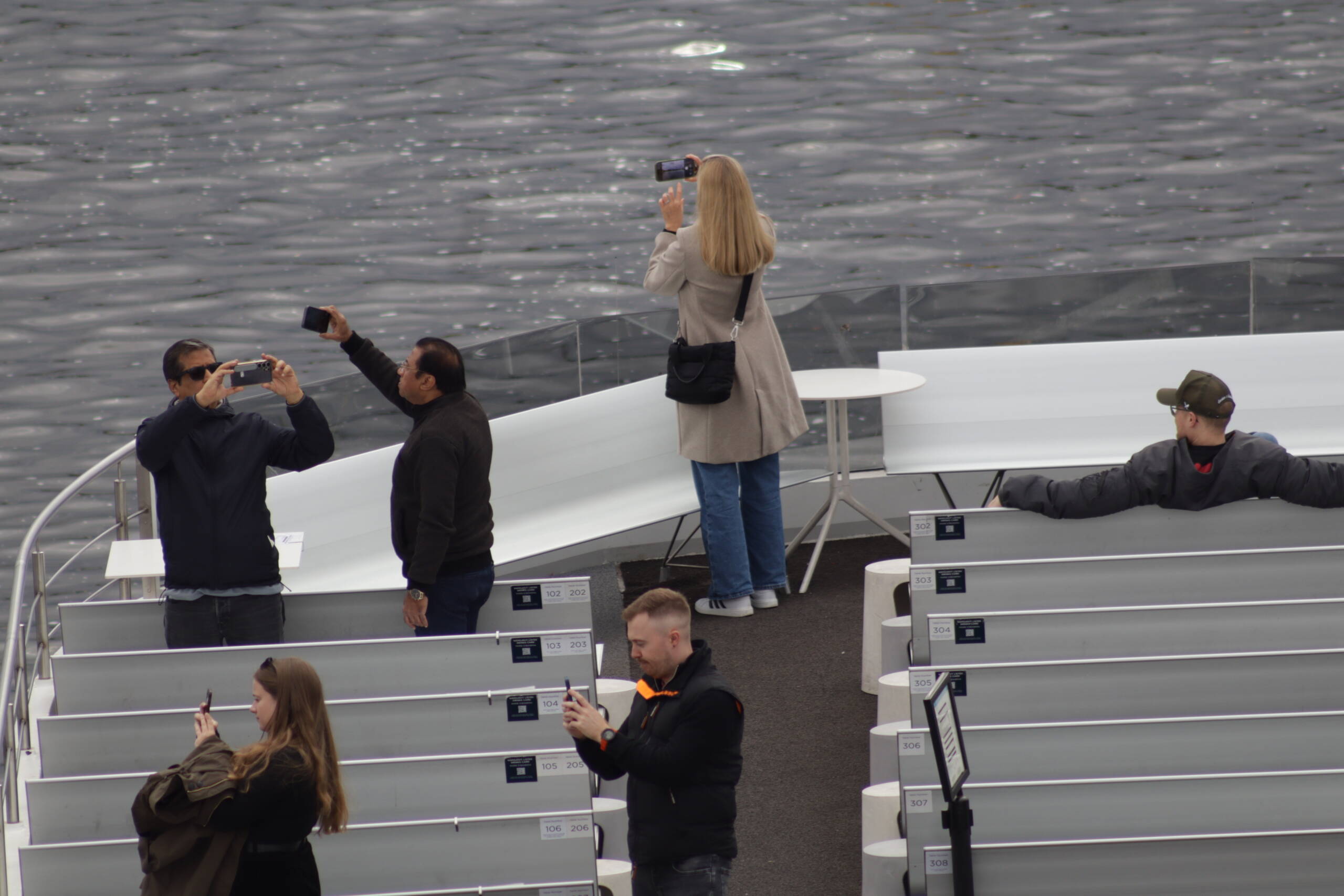
It’s almost funny when you watch it from a distance — a deck full of tourists, every single one holding up a phone, angling it just right, squinting against the light, trying to catch their perfect slice of the world. The image above captures this modern choreography perfectly: six travelers on a ferry, each absorbed in framing their moment — the woman in the beige coat aiming her phone at the water, another crouching into her shot, a man stretching his arm high as if to lift the horizon. The benches are nearly empty, the water ripples in the background, and yet the scene feels crowded with intent. Everyone here isn’t just seeing; they’re documenting. Every traveler today is, in some way, a photographer.
This instinct to photograph, to share, has transformed tourism from something passive into a self-sustaining ecosystem of micro-marketing. A single well-composed shot — a reflection on a canal, a morning coffee on a cobblestone street, the swirl of lights over a city square — can reach more eyes than the most expensive ad campaign. Cities have started to understand this and subtly (sometimes not so subtly) design for it. Look closely in places like Prague, Lisbon, or Venice and you’ll find railings positioned not just for safety but for framing, cafés that deliberately angle their seating toward landmarks, and murals whose colors pop just right on phone screens.
For tourism boards, this shift represents a remarkable opportunity. Instead of relying solely on professional campaigns, cities can amplify the authentic stories told by everyday visitors. But to do it effectively, they need to think like content creators. Simple interventions — well-placed signs that encourage geotagging, interactive landmarks that change with seasons or festivals, or digital installations that blend physical exploration with augmented layers — all invite sharing. Imagine a city-sponsored “photo quest” where travelers unlock hidden viewpoints or art pieces through a QR-based map, posting each find under a campaign hashtag. The result isn’t just engagement; it’s organic storytelling woven across thousands of timelines.
Yet there’s more than marketing here — there’s data. Every image uploaded carries metadata: where it was taken, what time of day, even what angle or focal length. Aggregated responsibly, this visual data becomes a map of curiosity. City planners could analyze where people naturally stop, which corners of a district are under-photographed, or how public spaces are used through the rhythm of images shared each day. It’s tourism intelligence drawn from spontaneous behavior rather than surveys.
There’s also the question of narrative ownership. For decades, tourism imagery was top-down — brochures showing idealized versions of cities. Now, it’s bottom-up. The images that dominate Instagram feeds are messy, real, sometimes out of focus — and that’s precisely what makes them credible. A smart city doesn’t fight this loss of control; it curates it. By engaging with travelers’ posts — resharing, crediting, or even displaying live visitor photos on digital billboards — a destination becomes participatory, alive to its visitors’ gaze.
Still, there’s a danger in over-curation. The moment a place becomes too Instagrammable, it risks flattening into cliché. Think of Santorini’s blue domes or Paris’s carousel shots — once enchanting, now algorithmic. The balance lies in creating environments that remain genuinely lived-in while still visually magnetic. Local details — artisans at work, daily markets, street musicians — can sustain visual diversity and narrative freshness long after a view has gone viral.
The photo you see above, then, isn’t just a casual moment on a boat. It’s a symbol of how travel has evolved. Each person absorbed in their screen is both audience and ambassador, creating content that feeds a vast, decentralized gallery of global wanderlust. The task for cities is not to resist this shift but to choreograph around it — to turn spontaneous image-making into collective storytelling. Because when every traveler is a photographer, every photograph is also a postcard, every post a quiet advertisement, and every shared image a chance for the city to be seen, remembered, and longed for once more.