The recently released “OECD Tourism Trends and Policies 2024” report is a comprehensive analysis of the current state and future outlook of the tourism sector across OECD member and partner countries. It offers a detailed examination of how the tourism industry has rebounded from the significant downturn caused by the COVID-19 pandemic and addresses the new challenges and opportunities that have emerged in its wake.
The “OECD Tourism Trends and Policies 2024” report provides valuable insights into specific destinations and emerging trends within the tourism sector. The analysis reveals how various destinations have adapted and innovated to overcome the challenges posed by the pandemic, while also capitalizing on new opportunities.
Specific Destinations:
Portugal has emphasized sustainable tourism through its Tourism Strategy 2027. This strategy focuses on reducing the seasonality index, doubling the number of educational qualifications, ensuring positive impacts on local residents, and encouraging energy efficiency among tourism businesses. The strategy also aims to increase overnight stays and tourism revenue significantly.
Japan is working to attract high-end tourists and foster regional revitalization. The Tourism Nation Promotion Basic Plan 2023-25 targets longer-staying and higher-spending visitors. Japan has designated 11 Model Tourist Destinations to encourage international tourists to explore beyond major cities and experience the unique nature, history, and culture of regional areas.
Iceland supports destination development through the Tourist Site Protection Fund and the Icelandic Route Development Fund. These initiatives help distribute tourists more evenly throughout the country, easing the strain on popular tourist destinations and benefiting local communities.
Morocco has significantly improved its tourism infrastructure with the introduction of a high-speed train connecting Tangier and Casablanca. This has reduced travel times and made lesser-known cities more accessible, thereby broadening the distribution of tourism benefits.
Austria has developed a comprehensive set of indicators under its Plan T – Master Plan for Tourism to monitor sustainable tourism development. This includes guest satisfaction, resident attitudes towards tourism, and the share of renewable energy used in the tourism sector.
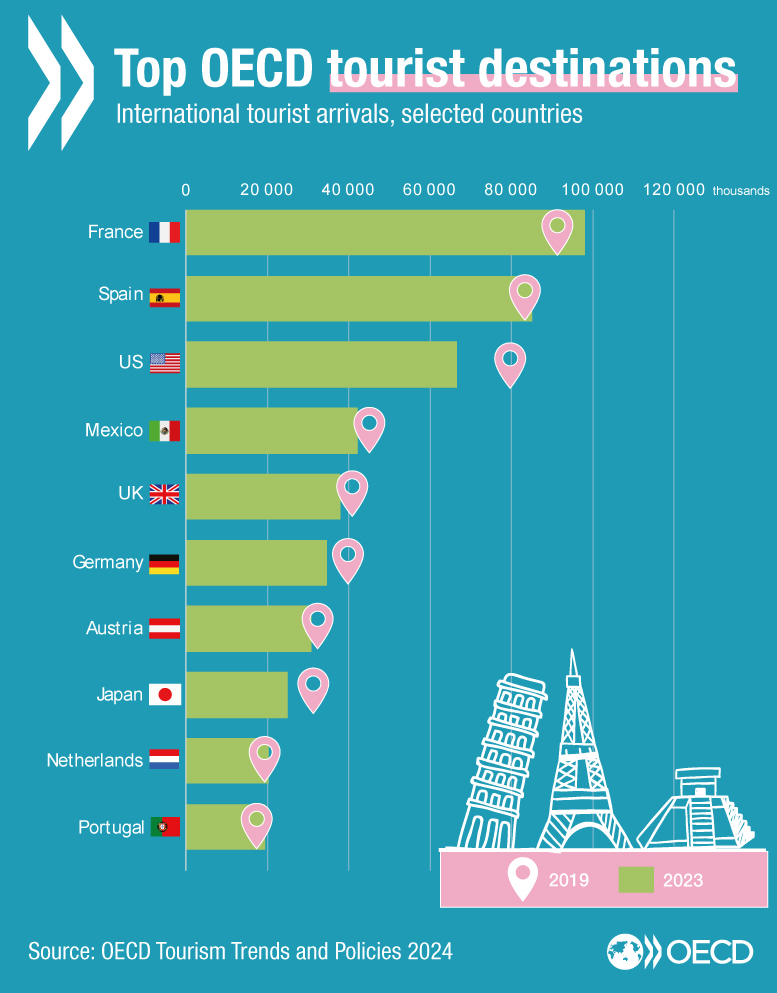
Tourism has shown a remarkable recovery, with some countries surpassing pre-pandemic levels of tourist arrivals and revenue. The report highlights that international tourist arrivals to OECD countries recovered to 77.3% of 2019 levels by the end of 2022, with a full global recovery projected by the end of 2024. This rebound has been driven by a strong return of international tourism demand following the lifting of travel restrictions, particularly in Europe, which benefited from significant intra-regional travel and a strong US dollar.
However, the recovery has been uneven, with some regions, particularly in Asia Pacific, lagging behind due to later reopening of borders and slower return of key source markets like China. The report notes that geopolitical tensions, cost-of-living pressures, and climate-related events continue to pose significant challenges to the sector. Countries such as Finland, Israel, and those neighboring Russia and Ukraine have seen slower recovery due to geopolitical conflicts.
The report underscores the importance of active, forward-looking policies to ensure the tourism sector’s resilience, sustainability, and inclusiveness. Governments at all levels have a crucial role in shaping tourism development to balance the economic benefits with the environmental and social impacts. Many countries have updated their tourism strategies to reflect the post-pandemic context, focusing on sustainable models, diversifying tourism offers, and managing visitor flows more effectively.
Key policy priorities identified include promoting coordinated action to boost tourism’s role in climate action, encouraging stakeholder engagement for more equitable benefits, and improving governance structures to better manage tourism development. Strengthening the tourism workforce is also a significant focus, with the need to attract, retain, and develop workers in the sector being crucial for its long-term resilience.
The report also emphasizes the need for better data and evidence to inform tourism policies. Developing more granular and timely data is essential for monitoring progress, understanding trade-offs, and making informed decisions. This includes exploring new methods to fill data gaps and designing tailored toolkits to monitor both short-term and long-term priorities.
In summary, the “OECD Tourism Trends and Policies 2024” report provides an in-depth analysis of the tourism sector’s recovery and future outlook, highlighting the importance of sustainable and inclusive policies to address new challenges and opportunities in the post-pandemic world.