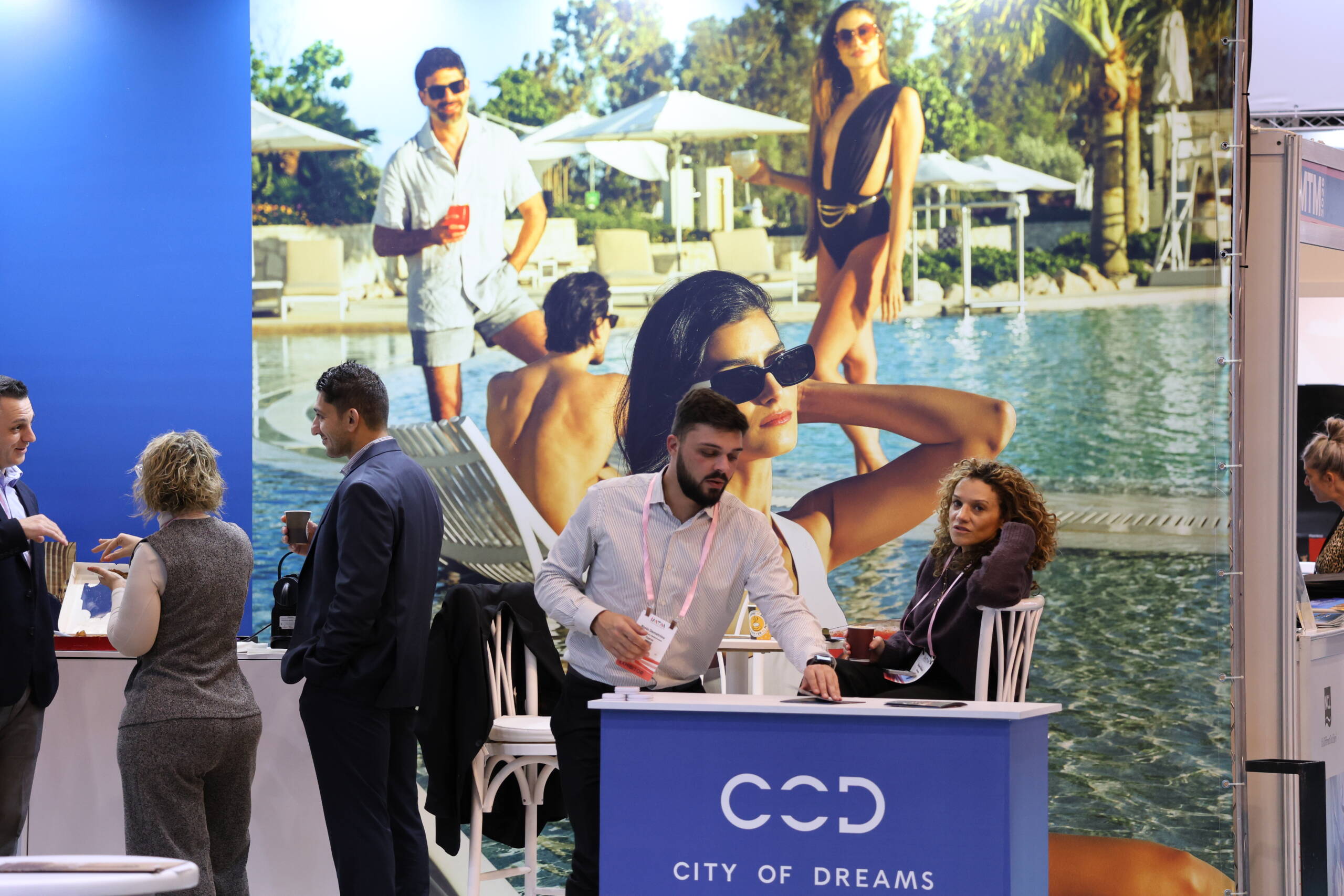
The first thing you notice in the image is the contrast, and it’s almost theatrical. In the foreground, a small trade-show booth with a clean counter, branded in calm blue, staffed by tired but alert professionals clutching paper cups of coffee. Lanyards hang loosely, jackets are draped over chair backs, conversations hover between polite sales pitch and genuine curiosity. Behind them, blown up to wall-size, a glossy poolside fantasy unfolds: sun-lit bodies, designer swimwear, cocktails raised mid-gesture, a kind of effortless leisure that feels permanently five minutes before golden hour. The gap between the two scenes is the entire story of travel trade shows in one frame. On one side, the promise we sell. On the other, the reality of selling it, standing for eight hours under exhibition lights, hoping the right person pauses long enough to listen.
So, does participation in travel trade shows actually pay off, or is it mostly ritual, a costly habit the industry can’t quite quit? The honest answer is uncomfortable, because it’s both yes and no, often at the same time. Trade shows rarely pay off in the simple, spreadsheet-friendly way many executives expect. You don’t book ten hotel nights for every badge scanned, and you don’t walk away with contracts neatly signed between panel discussions. What you get instead is exposure in its most literal form: being physically present when decisions are still vague, when partnerships are still half-ideas, when people are browsing rather than buying. That doesn’t convert cleanly, but it does compound, slowly and invisibly, which is why people keep coming back even when they complain about the cost.
The image captures another quiet truth. Notice how few people are actually looking at the giant poolside scene behind them. Most conversations happen sideways, half-turned, distracted by movement in the aisle. Travel trade shows aren’t really about spectacle anymore; everyone already knows what paradise looks like. They’re about trust, repetition, and recognition. When someone sees your logo for the third time in three different halls, or remembers your face from a coffee line and later from a panel Q&A, that’s when value begins to form. It’s not glamorous, and it doesn’t feel efficient, but it’s how long-term B2B travel relationships still get seeded.
There’s also the question of who benefits most, and here the answer is clearer. For large, established brands, trade shows are defensive territory. They’re about staying visible, signaling stability, reminding the market you’re still there, still funded, still relevant. For smaller players, destinations, boutique operators, or niche platforms, the payoff can be disproportionate if the positioning is sharp. A well-chosen show, a clear message, and a willingness to talk like a human rather than a brochure can open doors that cold emails never will. But showing up without a story, without a reason for being there beyond “everyone else is,” is how budgets evaporate quietly.
Look again at the people in the foreground. None of them look ecstatic, but none look disengaged either. This is the real emotional state of trade shows: suspended animation. You’re not closing deals, you’re not on vacation, you’re somewhere in between, performing relevance. The payoff, when it comes, usually arrives months later, in the form of an email that starts with “We met briefly in…” or a partnership that feels oddly familiar even though you can’t quite remember the first conversation. That delayed gratification is why trade shows frustrate CFOs and reassure marketers at the same time.
In the end, participation in travel trade shows pays off only if you stop measuring it like a direct sales channel and start treating it as infrastructure. It’s not about immediate returns; it’s about occupying space in the collective memory of the industry. The irony, perfectly captured by that oversized poolside backdrop, is that the dream you’re selling looks relaxed and spontaneous, while the process of selling it is anything but. Whether it’s worth it depends on whether you’re willing to play the long game, standing in uncomfortable shoes today so someone, somewhere, books a much more comfortable stay tomorrow.
Leave a Reply