The image catches a very specific winter moment: a lone runner cutting across a red track that slices cleanly through a wide rectangle of green turf, the whole scene flattened by crisp, low winter light. He’s mid-stride, airborne for a split second, shirtless except for the cold itself, black shorts and running shoes doing the bare minimum against the temperature. The trees behind him are stripped down to their branches, all lines and no leaves, and beyond them rises an Orthodox church with onion domes and crosses, its dark, rounded roof echoing the curve of the runner’s back as he leans forward. Farther still, Brooklyn’s apartment blocks stand quietly in the background, pale and rectangular, like they’re watching but not interfering. A few bundled figures linger at the edges of the field, walking slowly, reminding you just how cold −7 °C actually feels. The light is beautiful, almost generous, but it doesn’t soften the fact that this is winter, real winter, the kind that stings your lungs if you rush things.
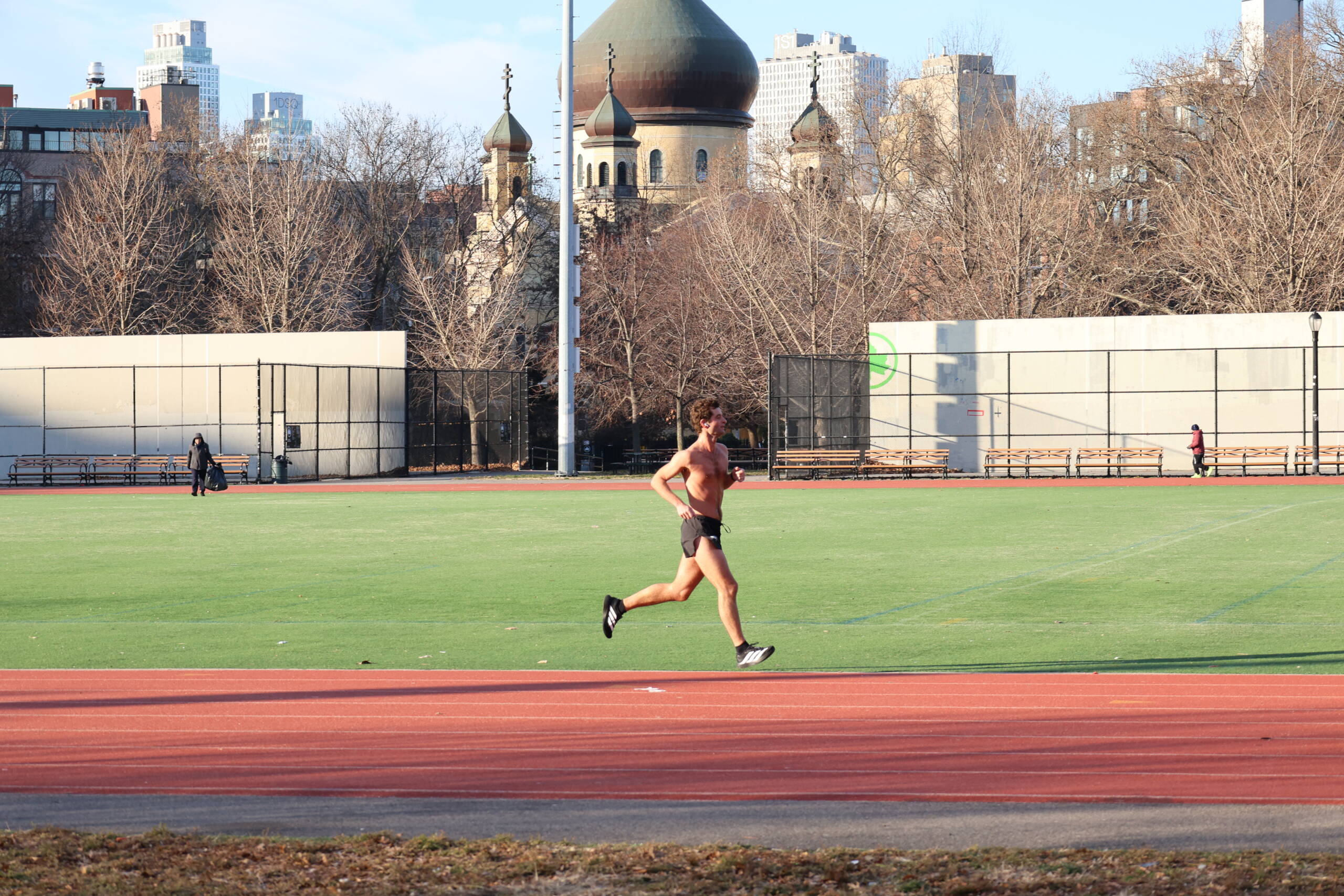
Health-wise, running at −7 °C sits right on an interesting boundary: it can be beneficial, but only under the right conditions, and it turns detrimental faster than many people expect. On the positive side, cold air is dense and oxygen-rich, which can make breathing feel oddly sharp and efficient once you’re warmed up. The body also works harder to maintain its core temperature, slightly increasing energy expenditure, and some people find cold runs mentally invigorating in a way that treadmill miles never are. Short to moderate runs, done with proper warm-up and at an easy to steady pace, are generally safe for healthy individuals, and they can even improve cold tolerance and mental resilience. There’s a certain clarity that comes from moving through cold like this—your senses are switched fully on, no autopilot allowed.
That said, −7 °C isn’t forgiving. Cold, dry air can irritate the airways, especially if you push intensity, sprint, or breathe hard through the mouth for long stretches; this can trigger coughing, chest tightness, or bronchospasm even in people without asthma. Muscles and tendons are also less elastic in the cold, which raises injury risk if you start fast or skip a proper warm-up. Running shirtless amplifies heat loss dramatically once sweat appears, and wind—barely visible in the photo but always present on open fields—can push exposed skin toward numbness surprisingly quickly. Hypothermia isn’t about collapsing dramatically; it often starts subtly, with coordination dropping and judgment getting fuzzy, which is exactly when people make bad decisions about “just one more lap.”
So the short answer is: yes, it can be beneficial, but only if it’s done thoughtfully. Warm up thoroughly, keep intensity controlled, cover extremities and core, and save the bravado for warmer days. At −7 °C, the cold isn’t an enemy, but it demands respect. Ignore it, and what looks like a strong, minimalist run can quietly turn from character-building into counterproductive, even risky, before you realize it.
Bare Skin, Busy Street: Cold Exposure in Motion, Manhattan
This second image shifts the scene from an open track to a tight Manhattan sidewalk, and that change matters. The runner—again shirtless, again in shorts—moves past a brick façade layered with graffiti and stickers, a resale shop window glowing behind him with warm interior light and mannequins in patterned jackets that look almost ironic given the bare skin outside. The pavement is dry, the curb slightly grimy in that familiar New York way, and the whole frame feels compressed: buildings close in, reflections multiply in the glass, pedestrians hover just out of frame. Unlike the Brooklyn track, where space and sunlight soften the cold, here the city feels harder, less forgiving. You can almost feel the wind tunneling down the street, bouncing unpredictably off corners and doorways, stealing heat in quick, sharp pulls. It’s not a heroic landscape; it’s ordinary, which somehow makes the exposure feel more extreme.
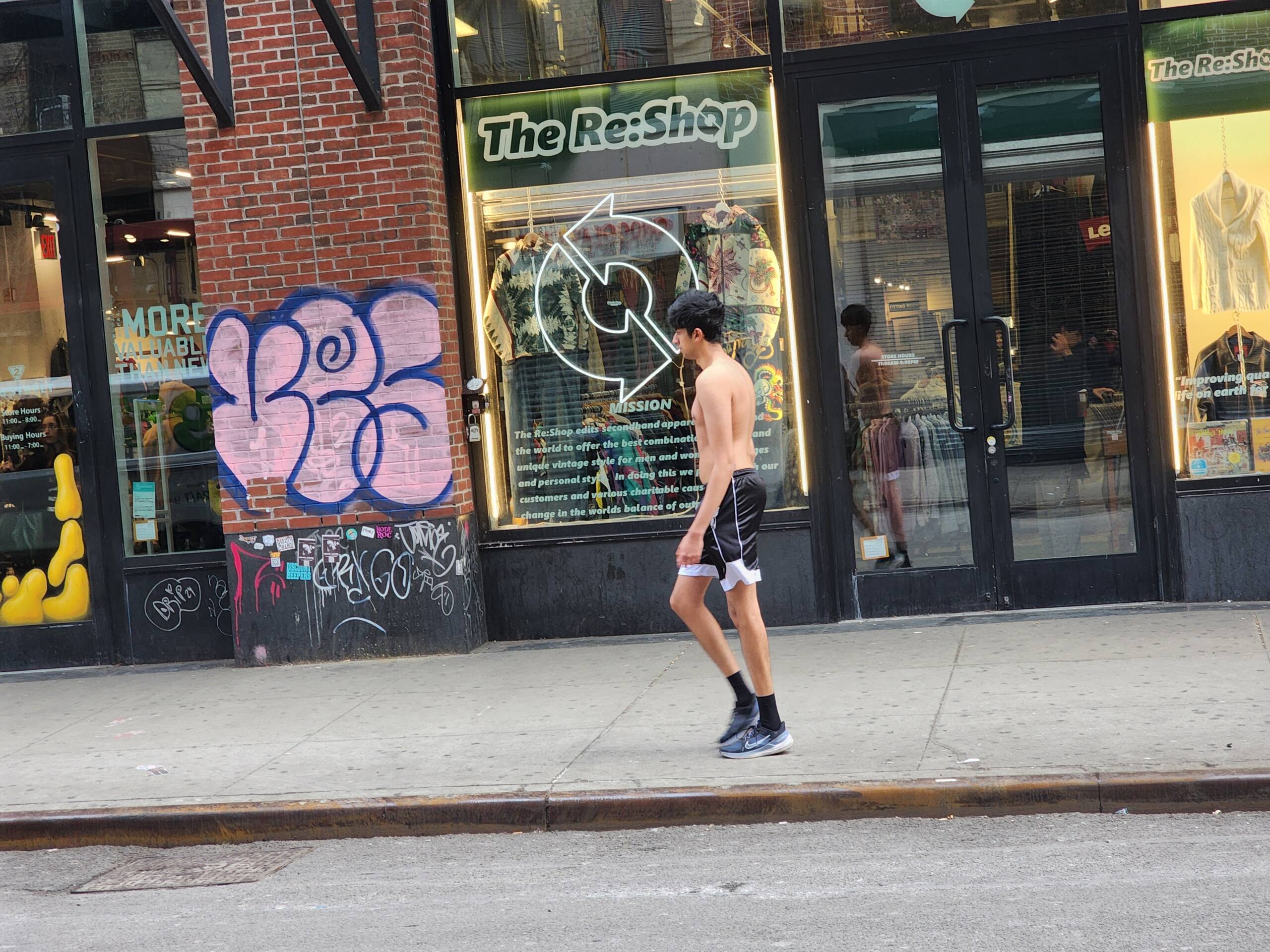
From a health perspective, the same basic rules apply as in Brooklyn, but the Manhattan context nudges the balance a bit further toward risk. Running shirtless in subzero or near-subzero conditions can still offer some benefits—mental toughness, a strong sympathetic nervous system response, a sense of alertness that borders on electric—but urban streets amplify the downsides. Stoplights, intersections, and uneven pacing mean more frequent drops in body heat once sweat appears, and wind chill in street canyons can push the effective temperature well below what the thermometer says. Cold, dry air hitting the lungs at variable intensity increases airway irritation risk, especially with repeated accelerations and decelerations. Add traffic stress, noise, and the need for constant situational awareness, and the body’s stress load stacks up faster than during a steady, controlled run in an open park.
So is it beneficial or detrimental? In Manhattan, it’s even more conditional. Short exposures, deliberate pacing, and a clear plan to stay warm immediately afterward can make it tolerable for a well-adapted runner. But shirtless street running in deep cold offers no extra physiological advantage over wearing a thin, breathable top, while it does raise the risk of excessive heat loss, muscle stiffness, and post-run chill. What reads visually as toughness or nonchalance often translates biologically into unnecessary strain. The city already asks a lot from the body; the cold just collects its fee faster.
Cold Skin, Hot Opinions: Are They Nuts?
It’s a fair reaction, honestly, and the photos invite it. You see bare skin against winter light, shorts where your brain expects layers, and your instinctive response is something like: this can’t be sensible. In the Manhattan image especially, the contrast is almost theatrical—warm shop lights glowing behind glass, padded jackets on display, graffiti and brick holding in the city’s stored heat, while this runner moves past with his torso exposed as if seasons were optional. It feels defiant, maybe performative, maybe just stubborn. The body looks relaxed, not panicked, but the setting keeps whispering that this isn’t a beach town and it definitely isn’t July.
Are they nuts? Not necessarily—but they are flirting with the edge of reason more than with any hidden health advantage. Some people deliberately cultivate cold tolerance through gradual exposure, and for a subset of runners this becomes part physiology, part identity. They’ve learned how long they can go, how their breathing behaves, how their skin feels before things turn from “bracing” to “stupid.” In that narrow sense, what you’re seeing isn’t madness so much as a practiced habit taken to a visible extreme. The problem is that from the outside, you can’t tell the difference between adaptation and bravado, and the city doesn’t care which one it is. Wind tunnels don’t reward experience, stoplights don’t pause hypothermia, and sweat doesn’t negotiate.
What is a little nuts is the cost–benefit math. Running shirtless in winter doesn’t unlock secret gains that a thin technical layer wouldn’t give you with far less risk. It increases heat loss, stiffens muscles faster, and makes post-run chill more likely, especially once motion stops. In urban settings, where pace is uneven and exposure is inconsistent, that risk multiplies quietly. So while these runners aren’t automatically reckless or unhinged, they are choosing a harder, less forgiving path for reasons that are often psychological rather than physiological. Call it toughness signaling, personal ritual, or just liking the feeling of cold on skin—but no, it’s not the optimal choice. It’s a choice that makes sense only if the point isn’t health efficiency, but experience. And that’s where your raised eyebrow is completely justified.