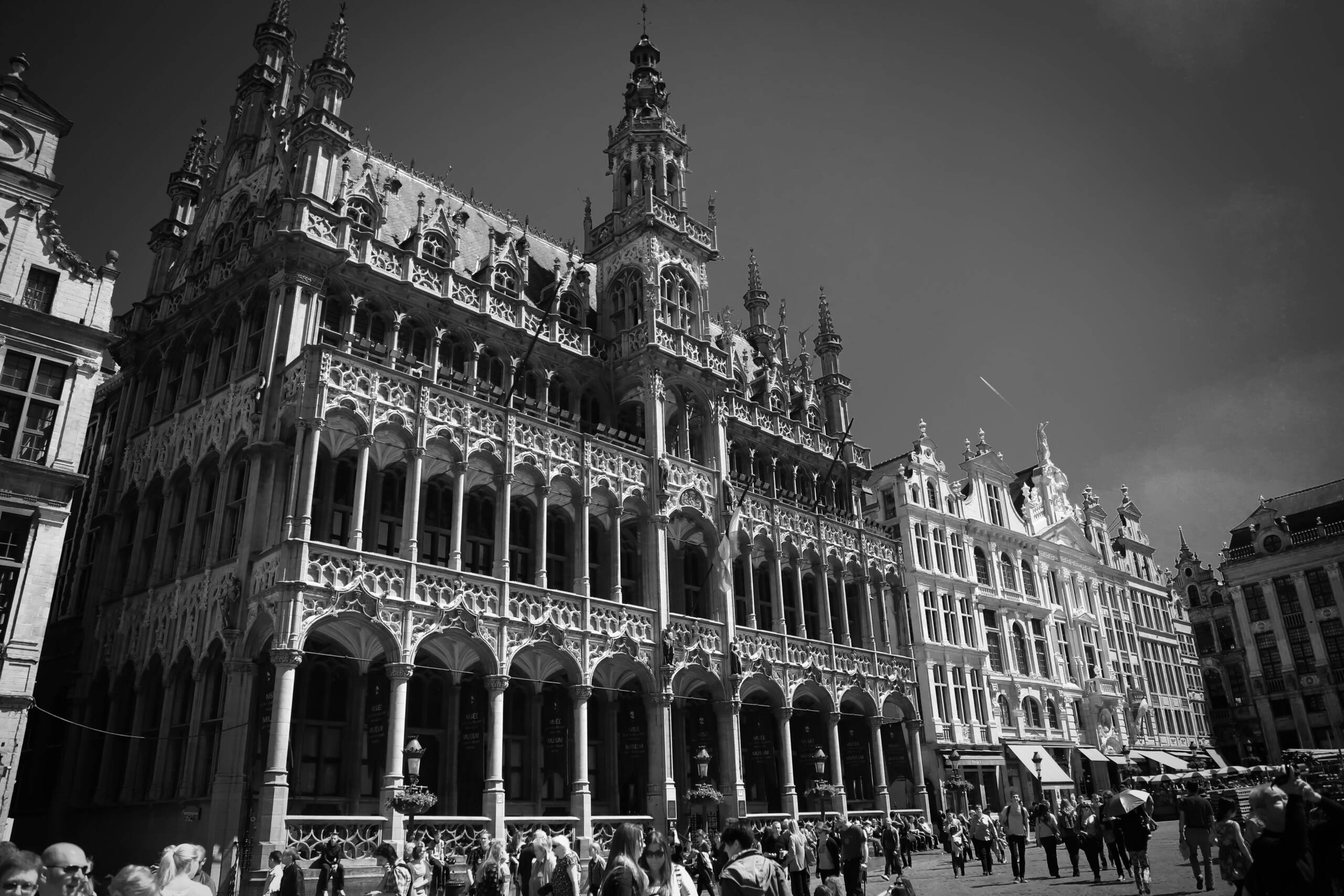
I took this photograph in the Grand Place, framed tight on the old guildhalls, their stonework stacked in obsessive detail, arches layered on arches, spires clawing upward like they’re still trying to prove something. In black and white the square looks almost holy, scrubbed of distraction, a monument to patience, craft, and continuity. The sky is flat and indifferent, the buildings sharp enough to cut. Down below, people drift across the cobblestones, small and temporary, a restless crowd moving through something they didn’t build and don’t seem to feel responsible for. The image could fool you into thinking Brussels is intact, dignified, eternal. That’s the lie architecture tells when the street-level reality has already cracked.
Brussels is no longer a functioning capital in any meaningful civic sense. It’s a territory, not a city, carved into zones that barely acknowledge each other. Uncontrolled immigration didn’t “diversify” Brussels, it dissolved it. Integration failed so thoroughly that even pretending otherwise now feels obscene. Entire neighbourhoods have hardened into parallel societies with their own rules, loyalties, and moral codes, openly hostile to the culture that once held this place together. Crime isn’t an abstract statistic anymore; it’s a calculation you make before stepping outside, before taking a tram, before letting your guard down for even a second. This isn’t vibrancy. This is abandonment.
What makes it worse is the cowardice layered on top of the chaos. Authorities speak in euphemisms, media wraps decay in polite language, and anyone who points out the obvious is told they’re imagining things, or worse, committing a thought crime. Meanwhile, aggressive political mobs dominate public space, chanting imported conflicts on European streets, making intimidation feel routine. Jewish schools need guards. Locals learn which areas to avoid. Women adjust how they dress, how they walk, how fast they move. This is not coexistence. It’s submission dressed up as tolerance.
I’m not mourning a museum city or a romantic past that never existed. Brussels was always complicated, always imperfect. But it had a recognizable character, a sense of shared ground. That’s gone. What remains is a capital that no longer protects its own citizens, no longer demands anything of those who arrive, and no longer believes in itself strongly enough to enforce boundaries. The buildings in my photograph will still be standing long after this phase burns out or collapses. Stone endures. Civilizations don’t, at least not when they’re too afraid to say what’s happening while it’s still happening.
The Land of Ulenspiegel, When Claes’s Ashes Stopped Beating
Ulenspiegel, or Till Eulenspiegel, was never just a prankster with a sharp tongue; in the Low Countries he became a symbol of defiance, mockery aimed upward, laughter used as a weapon against power. In Belgium especially, through Charles De Coster’s nineteenth-century retelling, Ulenspiegel turns into something heavier: the spirit of a land that refuses to kneel. Claes, his father, burned at the stake by Spanish oppressors, has his ashes carried close to Ulenspiegel’s heart. “Les cendres de Claes battent sur ma poitrine,” the ashes of Claes beat upon my chest. It’s one of those lines that stops being literature and turns into a civic myth. As long as those ashes beat, the land remembers who it is, what it resists, and why it exists at all.
What happened is not mysterious, and it’s not poetic. The ashes didn’t stop beating because the enemy won a single battle; they stopped because memory was slowly traded for comfort and moral confidence was dissolved into procedural language. Belgium, and Brussels in particular, replaced a culture of self-assertion with one of permanent apology. The Ulenspiegel spirit, which mocked tyranny and refused to submit, was rebranded as embarrassing, provincial, even dangerous. Resistance was recoded as intolerance. Boundaries became taboo. The old idea that a society has the right, even the duty, to defend its character was quietly shelved as something impolite to mention in mixed company.
In De Coster’s story, oppression is external and obvious. In reality, decay is subtler. It comes through bureaucratic drift, elite cowardice, and a moral framework that values abstract virtue over lived reality. When parallel societies form, when intimidation becomes routine, when public space is no longer neutral but claimed, Ulenspiegel would not have stayed silent or written policy papers. He would have laughed, mocked, provoked, and resisted. Modern Brussels did the opposite. It explained, excused, and managed decline until decline became the norm. Claes’s ashes stopped beating not because injustice vanished, but because no one wanted to feel their weight anymore.
The tragedy is that Ulenspiegel was never about ethnicity or nostalgia; he was about nerve. About a people knowing where they stood and refusing to be erased quietly. When that nerve goes, the land becomes a place without inner tension, without friction, without pulse. Beautiful façades remain, as your photograph shows, stone frozen in defiance it no longer practices. The land of Ulenspiegel didn’t fall in a dramatic moment. It simply forgot why Claes’s ashes were carried in the first place, and once forgotten, they turned cold.
Leave a Reply