A shift back toward routine is beginning to take shape in Israel’s aviation sector, with authorities preparing for a full resumption of operations at Ben Gurion Airport starting at midnight. The decision follows a formal situation assessment conducted by the Ministry of Transportation, signaling that conditions are now considered stable enough to restore regular air traffic after a period of disruption.
Behind the scenes, coordination between the Israel Airports Authority and the Civil Aviation Authority has been ongoing, focused on aligning operational readiness with security realities. These are not purely technical decisions—they sit at the intersection of logistics, risk assessment, and public confidence. Reopening a country’s primary international gateway is as much about signaling stability as it is about moving planes.
The timing is also deliberate. By pushing the official announcement to follow the end of the holiday, authorities are managing both public communication and operational rollout with a degree of control, avoiding confusion during a period when attention and mobility patterns are already atypical. It’s a small detail, but it reflects how carefully staged these transitions tend to be.
For travelers, airlines, and the broader economy, the reopening marks a return to flow—of people, goods, and connections. Ben Gurion Airport is not just infrastructure; it is a pressure valve for movement in and out of the country. When it pauses, the effects ripple outward quickly. When it resumes, even gradually, the sense of reconnection tends to follow just as fast.
Still, the underlying reality hasn’t changed overnight. The reopening doesn’t erase the conditions that led to the disruption in the first place. It simply marks a point where systems—security, aviation, governance—have recalibrated enough to function again under current constraints. That distinction matters, even if it’s not always visible on a departure board.
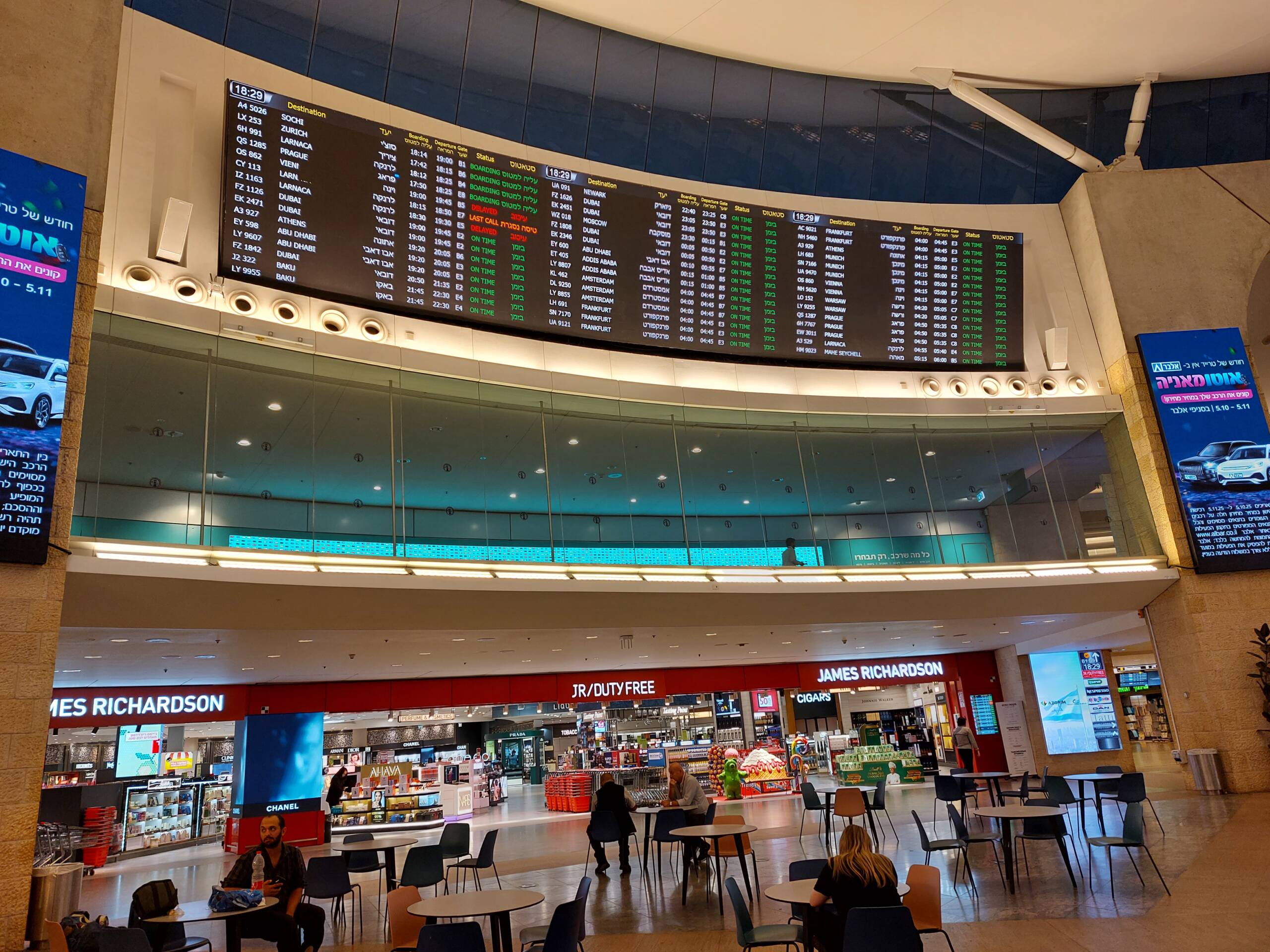
Departure Boards Flicker Back to Life at Ben Gurion
The image captures a moment that feels transitional, almost like the airport itself is waking up again. High above the terminal floor, a long, slightly curved digital departure board stretches across the upper wall, packed with rows of destinations—Zurich, Larnaca, Prague, Dubai, Abu Dhabi—each line glowing in green with reassuring “ON TIME” statuses. A few entries stand out in red and yellow, subtle reminders that the system hasn’t fully smoothed out yet, that normalization is still in progress rather than complete.
The architecture frames the scene in layers. A glass mezzanine runs beneath the board, reflecting cool blue tones from the ceiling panels above, giving the whole upper section a slightly futuristic, almost sterile calm. Below that, the mood shifts. The duty-free area is open and lit, anchored by the bold red signage of JR/DUTYFREE and James Richardson, the kind of visual constant that signals the airport’s commercial heartbeat is back online. Shelves are stocked, displays are bright, and everything looks ready—maybe even overly ready—for the return of crowds that aren’t fully there yet.
What stands out most is the space. Tables and chairs are scattered across the foreground, but only a handful of people occupy them. A man sits alone with a bottle of water, another person leans forward at a nearby table, and a woman sits with her back turned, slightly hunched, as if waiting rather than traveling. The emptiness between them is noticeable. Airports are usually dense with motion—rolling suitcases, overlapping conversations, that low constant hum—but here there’s a pause, a kind of held breath.
On the far sides, digital advertising screens in Hebrew continue their cycle, indifferent to the moment, promoting cars and offers as if nothing had changed. And maybe that’s the point. The systems—commercial, logistical, visual—are all back in place. The departure board is populated, the shops are open, the lights are on.
But the human layer hasn’t fully caught up yet. It feels like the first hours of reopening, when everything is technically operational, yet still waiting for the world to flow back in and make it real again.
Leave a Reply