There is a particular quality to Lisbon’s light in early October — hard and white and merciless, the kind that strips a city down to its architectural bones and forces an honest reckoning. No golden-hour flattery, no ambient softening. Just limestone and cobblestone and the wide grey-green muscle of the Tagus pushing toward the Atlantic. It is a city that rewards the visitor who shows up in the off-peak shoulder season, when the tour buses still come but the worst of summer’s crowds have retreated, and you can stand in front of something genuinely extraordinary and feel something other than the elbows of strangers.
The itinerary ran from Belém in the west to the Baixa in the east, a loose arc across the city’s most legible landmarks. What follows is not a checklist. It is a report from a city still processing what it once was, and what that history means in an age that has grown ambivalent about empire.
Belém: Where Portugal Launched the World
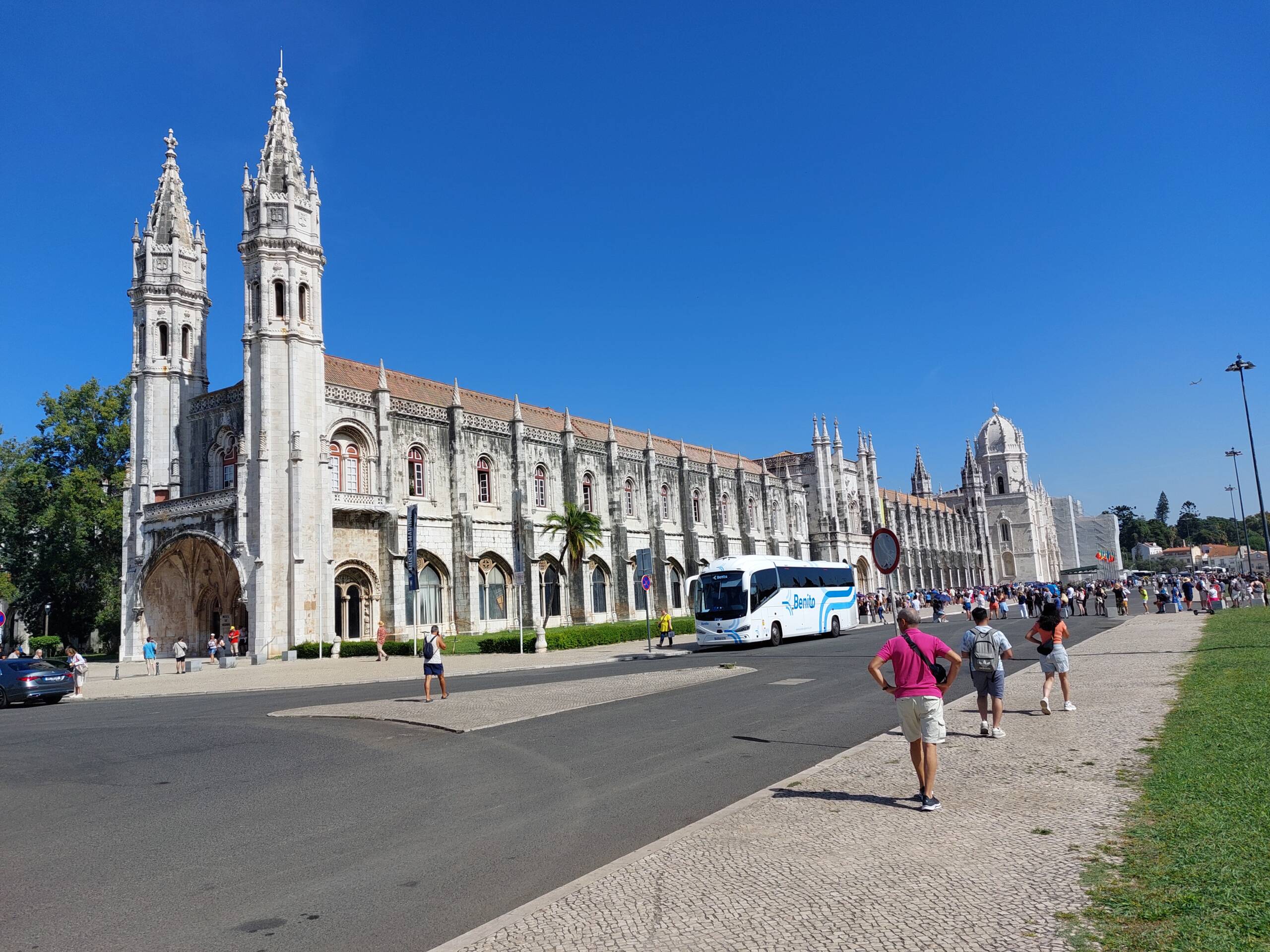
The Mosteiro dos Jerónimos is the most convincing argument Lisbon makes for its own greatness. Commissioned by King Manuel I in 1501 to commemorate Vasco da Gama’s return from India and consecrated in 1601, the monastery took a full century to complete, and the accumulated ambition shows in every surface. The style — Manueline, named after the king himself — is Late Gothic folded into something stranger: maritime ropes and armillary spheres and coral formations worked in limestone, a carved vocabulary that could only have emerged from a nation whose wealth was arriving by sea from places most Europeans couldn’t find on a map.
Standing across the road from it on a Tuesday morning, shielding your eyes from the direct sun, you understand immediately why UNESCO added it to the World Heritage list in 1983. The facade runs for nearly 300 meters. The twin towers at the western end frame the whole composition with a verticality that pulls the eye upward, and then the horizontal rhythm of the arcade takes over and pulls it east again, and the eye keeps moving, keeps discovering. A tour coach — Benito, the livery read — blocked the central portal for a few minutes and it hardly mattered. The building is too large to be defeated by a bus.
The interior cloister is considered the finest example of the Manueline style in existence. The exterior, caught in full October sun, is the image that stays.
Torre de Belém: The Postcard That Earned It
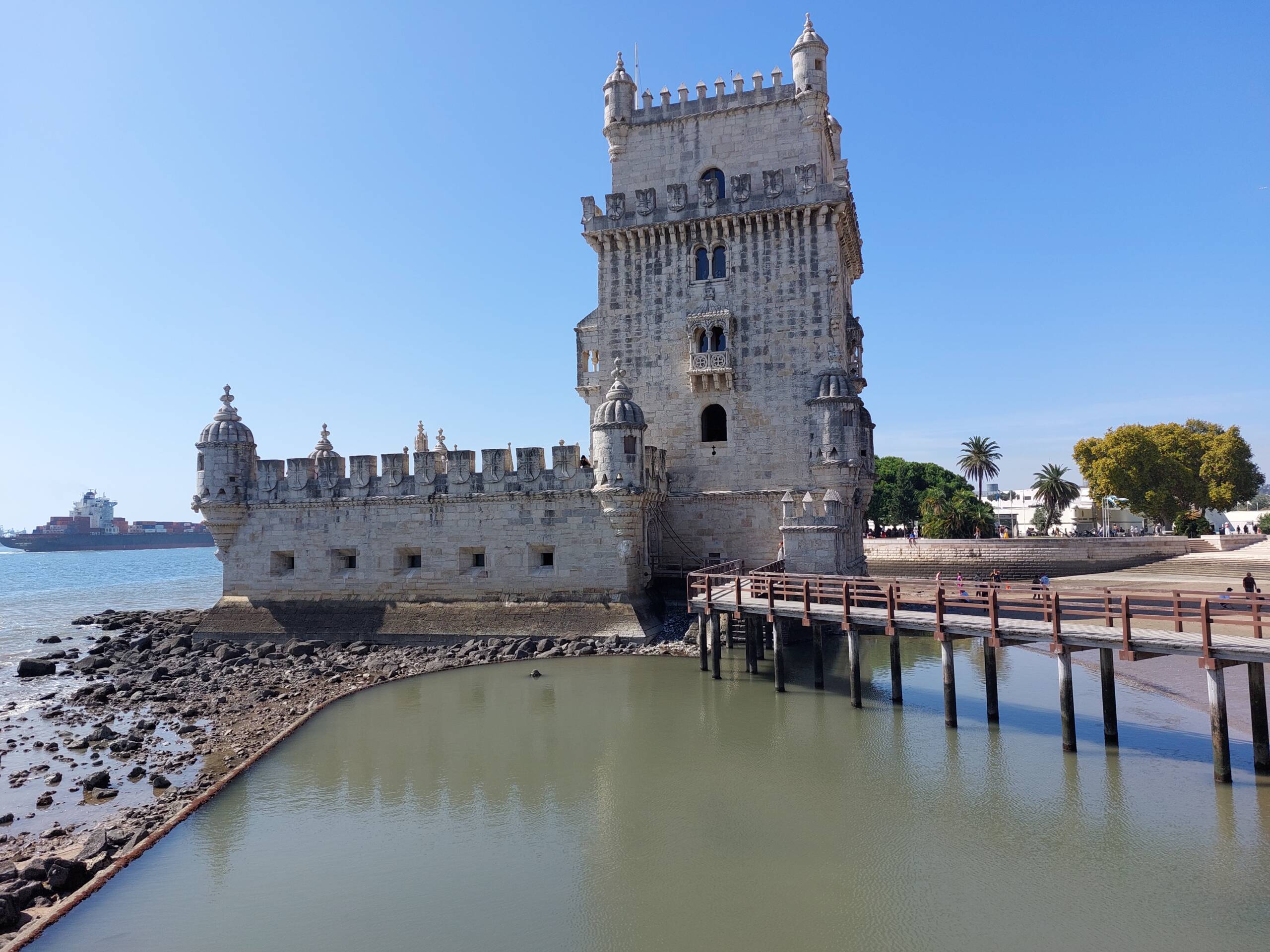
The Tower of Belém sits roughly 1.5 kilometers west of the monastery, at the river’s edge, connected to shore by a wooden footbridge. It was built between 1516 and 1521 as a combined ceremonial gateway and defensive fortification, positioned to guard the approach to Lisbon from the sea. Francisco de Arruda designed it; King Manuel I commissioned it. The same Manueline aesthetic governs it, though the scale here is intimate — a four-story tower rising from a two-story bastion, carved with Moorish-influenced windows and armillary spheres and the cross of the Order of Christ.
At low tide, as it was on this particular morning, the bastion sits on exposed rock surrounded by a shallow moat of greenish water. A cargo ship was transiting the river in the background, rust-red hull catching the same light that was bleaching the tower’s limestone face. The juxtaposition is not subtle — here is a structure built to announce Portuguese maritime power, and here behind it is the modern working river, container traffic heading to Lisbon’s port. Five centuries collapsed into a single frame.
The Tower of Belém is one of those rare monuments that actually delivers on its reputation. It looks like its photographs because its photographs look like it.
Padrão dos Descobrimentos: A Monument Arguing With Itself
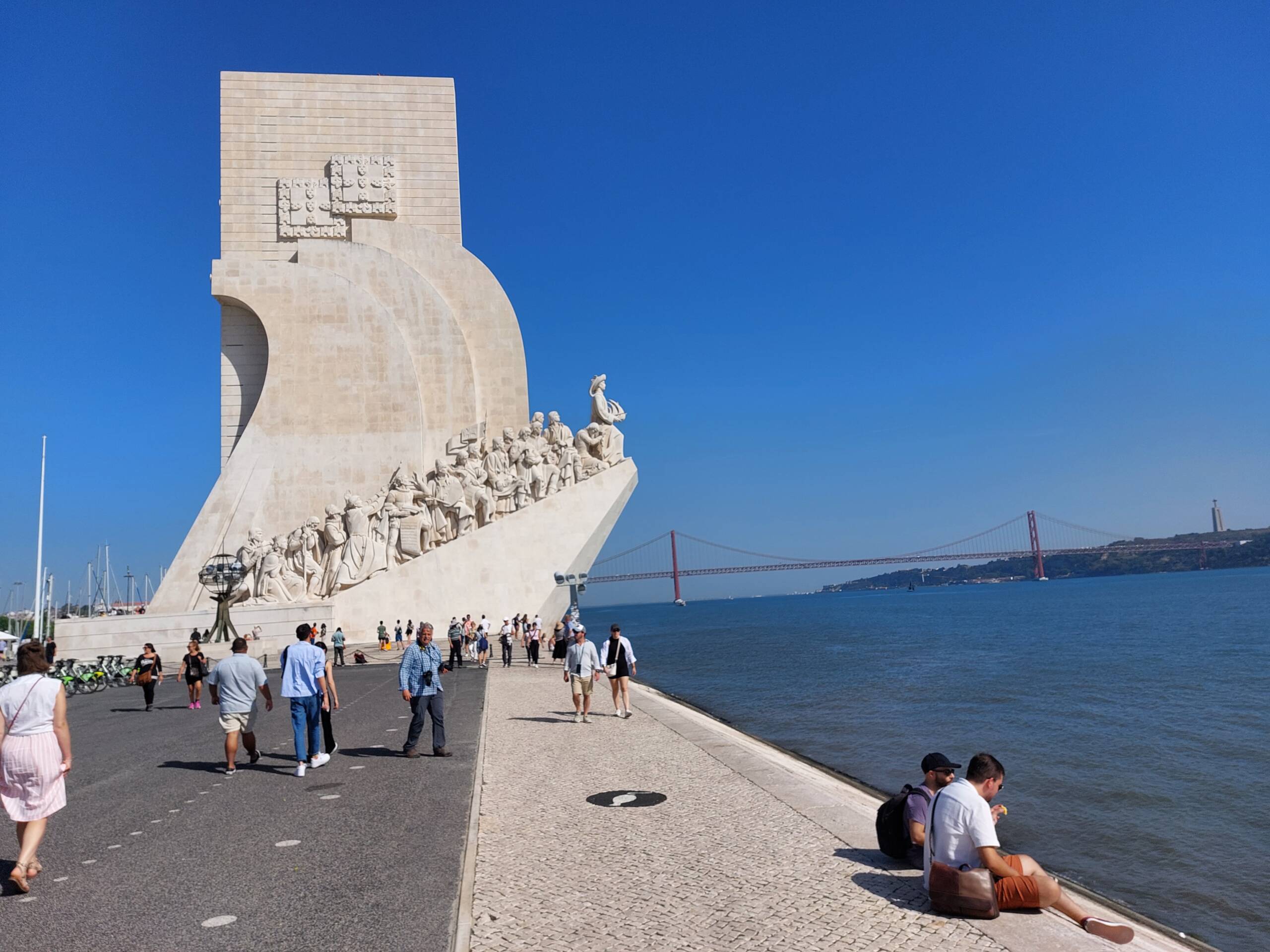
The Monument to the Discoveries stands on the Tagus riverfront between the monastery and the tower, a 52-meter slab of reinforced concrete faced in limestone, shaped like the prow of a caravel. It was built in 1960 — the Salazar dictatorship’s 500th anniversary commemoration of Prince Henry the Navigator’s death — and this origin story shadows every visit to it. The dictatorship used the Age of Discovery as propaganda, a mythology of national greatness deployed to distract from political repression and an increasingly brutal colonial war in Africa. The monument was commissioned in that context, and it shows.
Henry the Navigator stands at the prow, holding a model ship. Behind him, in two cascading lines down each flank, are 33 figures: explorers, cartographers, missionaries, artists, kings. Vasco da Gama, Ferdinand Magellan, Luís de Camões. The monument has the aesthetic confidence of a regime that didn’t expect to be questioned. Portugal has been questioning it ever since the Carnation Revolution of 1974.
What saves the monument from pure ideology is the view from its base. The Tagus is wide here — so wide it was once mistaken by early navigators for a river mouth leading to a vast inland sea. On the opposite bank, the hills of the Arrábida peninsula rise hazy and blue. The Ponte 25 de Abril bridge, completed in 1966 and modeled closely on San Francisco’s Golden Gate, stretches across the water in the middle distance. Its name changed after the revolution — it was called the Salazar Bridge until 1974 — which gives it a different kind of historical weight than its American counterpart. A bridge that had to be renamed because its original namesake became politically untenable is a bridge carrying layers of meaning that no amount of structural engineering can span.
Standing on the cobblestone esplanade beside the monument on a clear October afternoon, watching tourists drift past and a few locals eat lunch at the water’s edge, the monument reads as Lisbon always reads: beautiful, complicated, not entirely at peace with what it is.
Downtown: The Baixa and Rua Augusta
The Marquis of Pombal rebuilt central Lisbon after the catastrophic earthquake of November 1, 1755. The quake, which struck on All Saints’ Day when most of the population was in church, killed an estimated 30,000 to 40,000 people and leveled most of the medieval city. Pombal, the chief minister of King José I, treated the disaster as an engineering problem. He had the ruins cleared before the dead were fully buried. He built the Baixa — the lower city — on a rational Enlightenment grid, the first planned earthquake-resistant urban district in European history.
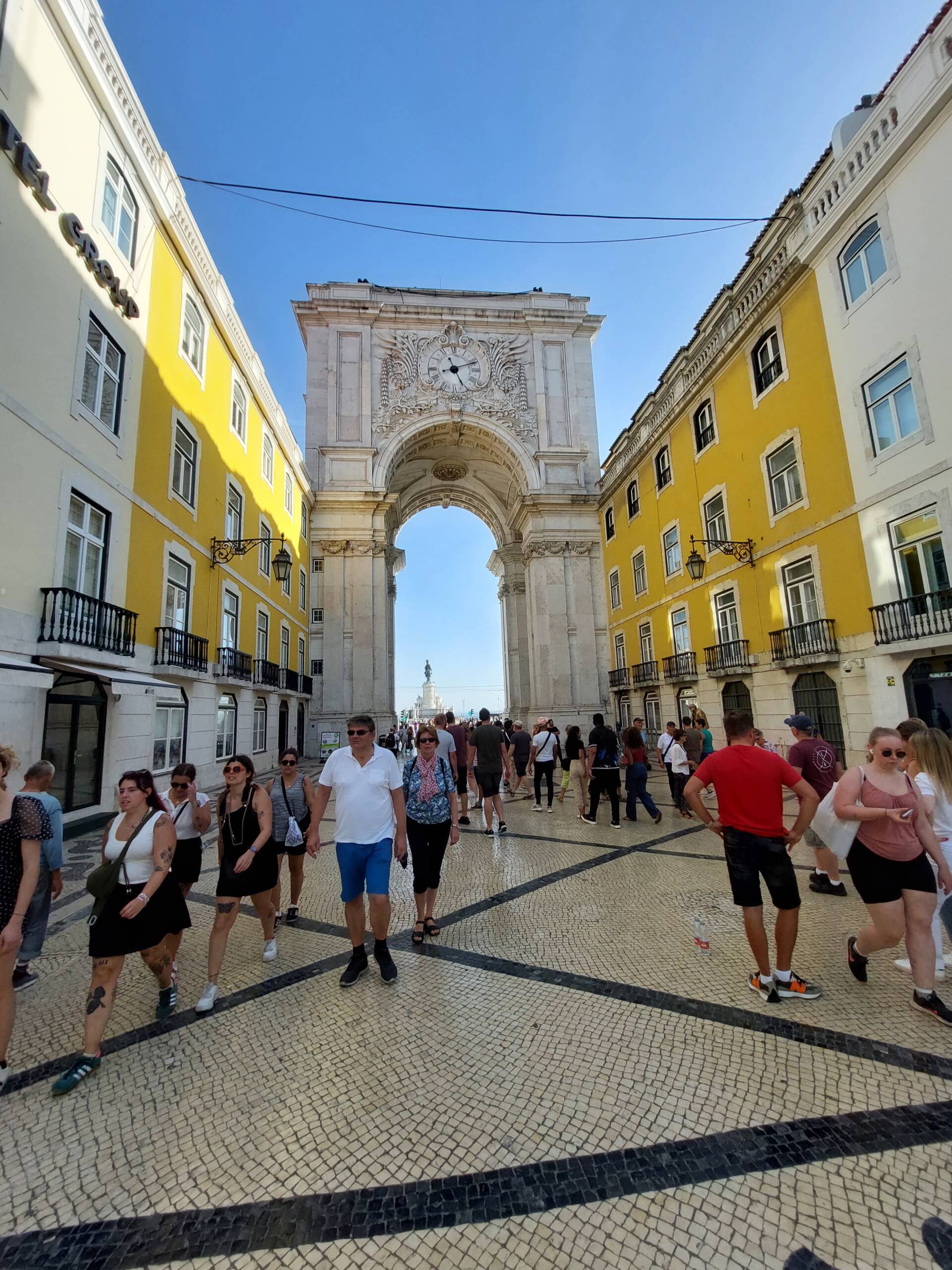
The Rua Augusta runs the length of that grid, north to south, terminating at the Praça do Comércio and the river at one end and opening toward the Praça do Rossio at the other. At its southern terminus, closing the street’s perspective line before it opens into the square, stands the Arco da Rua Augusta, a triumphal arch completed in 1875 — nearly a century after the reconstruction it was meant to celebrate. It carries a clock face in its upper register and allegorical sculpture on its crown, and it is framed, when you approach from the north along the Rua Augusta, by the yellow ochre facades of the flanking Pombaline buildings, their iron balconies and carved window surrounds holding the street together.
In the mid-afternoon of a Tuesday, the Rua Augusta was thick with people — tourists moving at tourist speed, locals cutting through with the practiced impatience of people who live next to a landmark. The cobblestone mosaic underfoot, black basalt on white limestone, makes abstract wave patterns that extend across the whole Praça do Comércio. It is the kind of detail that only registers when you look down, and most people don’t look down.
The arch frames, through its central opening, the equestrian statue of King José I in the square beyond. Pombal commissioned it. Pombal arranged to be depicted at its base. The earthquake destroyed the old city, and Pombal built a monument in which he cast himself in bronze alongside the king he served. Lisbon has a gift for this kind of historical compression.
The Upper City: Churches and Color
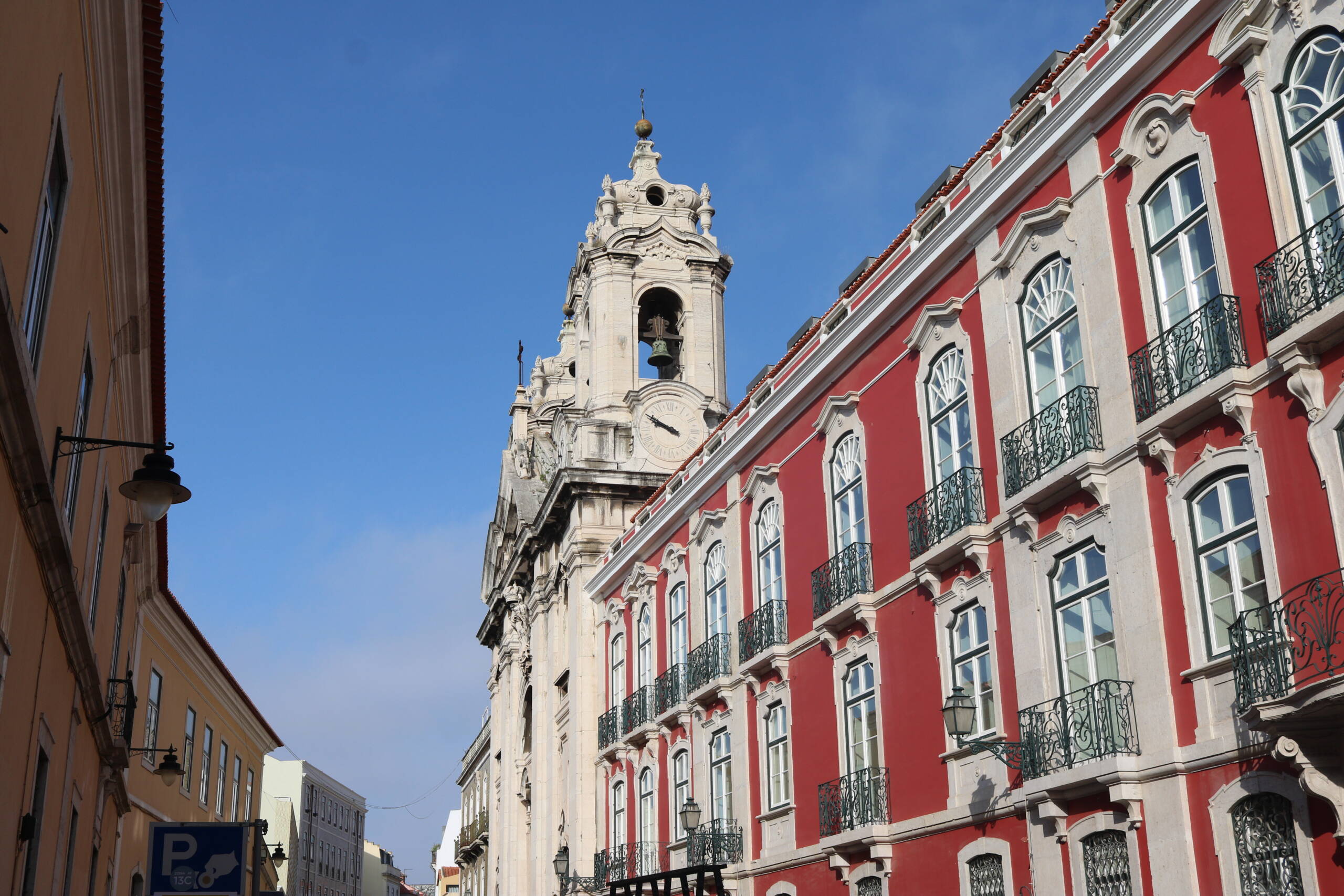
Above the Baixa, toward the Chiado and the Bairro Alto, the city shifts register. The planned grid dissolves into the older organic street pattern that the earthquake didn’t fully erase — narrower lanes, steeper grades, the sudden appearance of a Baroque church tower around a corner. The city’s palette changes too. Where the Baixa runs to cream and ochre, the upper quarters admit deeper tones: the dark red of the building on the Largo do Chiado that stands next to the Igreja dos Mártires, its Baroque tower visible from several blocks away, white limestone against deep terracotta, wrought iron balconies scaling four stories of fanlight windows.
It is a particular kind of Portuguese urban beauty that operates through contrast and accident rather than plan. No one designed the relationship between that red facade and that white tower. It emerged from centuries of adjacent decisions, each building asserting itself without reference to its neighbor, and arriving somehow at coherence. The blue parking sign at street level, the iron streetlamp jutting from the wall at the frame’s left edge — they don’t diminish it. They confirm that this is a city still in use, not a museum diorama.
Lisbon’s architecture rewards the turned head, the glance up the alley, the willingness to leave the established route and take the next street over just to see what’s there.
Pastel de Nata: The Only Food Argument Worth Having
The pastel de nata is a custard tart in a flaky pastry shell, baked at extremely high heat until the custard surface scorches in irregular dark patches. It was developed by Catholic monks at the Jerónimos Monastery in Belém sometime before 1820 — the monks used egg whites to starch their habits and had surplus yolks, which became the tarts. When the monastery closed during the Liberal Revolution, the recipe passed to a nearby sugar refinery, which opened the Pastéis de Belém bakery in 1837. That bakery is still operating. The recipe remains proprietary. Every other bakery in Portugal makes its own version and calls it pastel de nata; only the Belém original can legally call its product pastel de Belém.
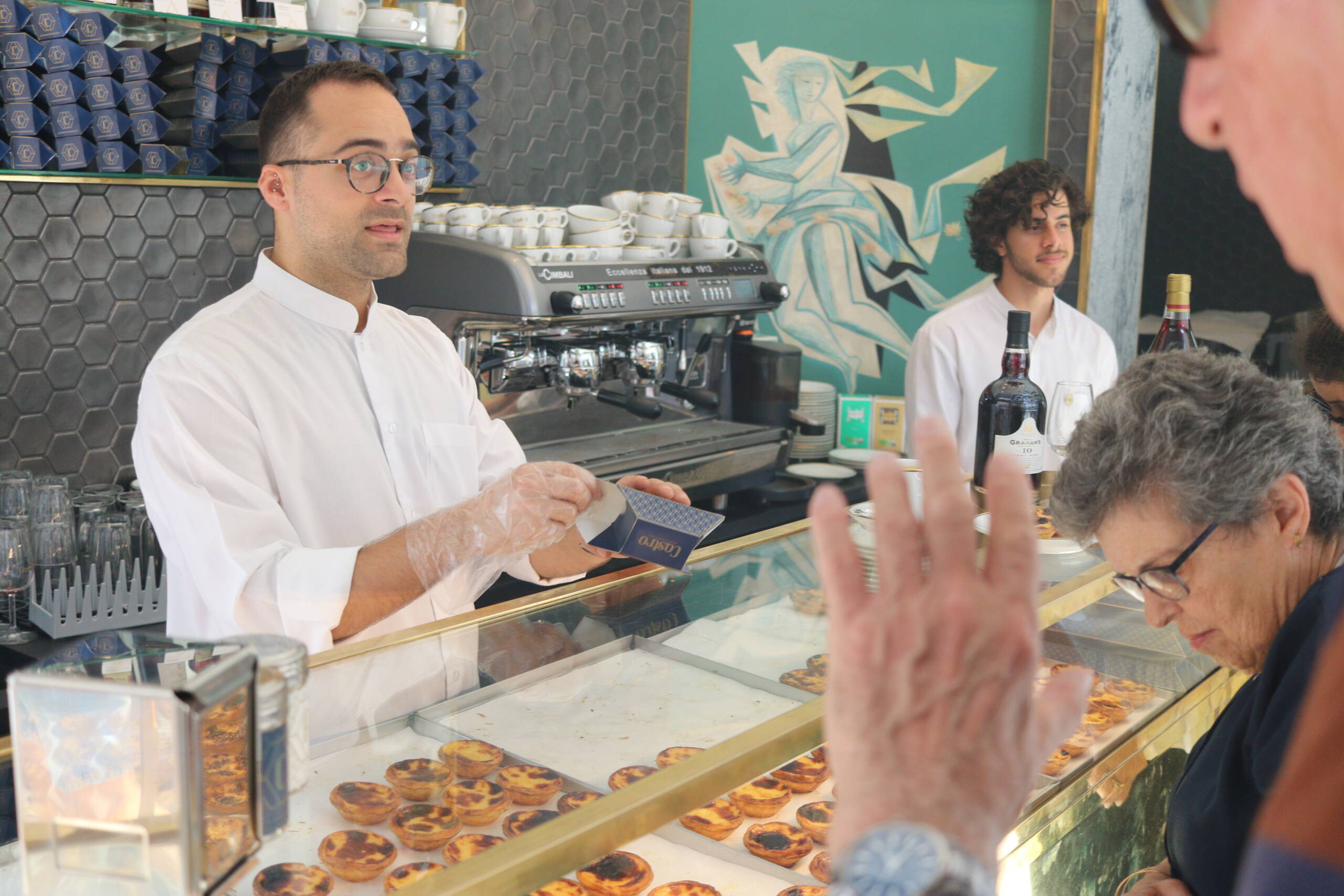
The tarts on display in the glass case at this particular café — the branding read Castro — sat in neat rows, still warm from the oven. Behind the counter, a barista in a white jacket handled the orders with the efficient friendliness of someone who has explained the menu a thousand times and doesn’t resent it. A La Cimbali machine anchored the coffee side of the operation; Graham’s 10-Year Tawny Port stood ready for the afternoon crowd that prefers something with more authority than espresso. The Art Deco mural behind the counter depicted a female figure in motion, the teal and cream palette holding the room together.
The tart is best eaten immediately, still warm, dusted with cinnamon if you choose, with a bica — the Portuguese espresso — alongside. It is one of the few things in European food culture that fully matches its reputation. The custard is eggy and slightly loose at the center, the pastry shatters correctly, the caramelized surface adds a bitter edge that keeps the whole thing from being simply sweet. It is a precise object that rewards precision in how you eat it.
What Lisbon Is
Lisbon is a city that has been processing loss for five centuries. The earthquake took the medieval city. Salazar took the republic. The colonies left, one by one, across the 1970s. The emigration waves took a generation of young Portuguese to France and Germany and Brazil. What remains is a capital that has had to rebuild its sense of itself several times over, and that process of rebuilding — the evidence of it in every mismatched architectural layer, in every street renamed after a revolution, in every conversation about whether the monument on the waterfront celebrates something that should be celebrated — gives the city a texture that newer, more uniformly prosperous cities don’t have.
It is also, in the plainest possible terms, beautiful: the light, the tiles, the river, the limestone that the centuries have weathered to exactly the right shade of grey. A day spent walking it from Belém to the Baixa is a day that earns its tiredness.
Come in October. The light is honest and the crowds are manageable and the custard tarts are always warm.