The square feels settled, almost self-assured, as if it has no need to impress anyone passing through. In the foreground, a bronze bust rises from a stone pedestal, framed by planting that refuses strict geometry. Purple flower spikes lean into red blossoms, ornamental grasses blur the edges, and large, glossy leaves push upward behind the monument, giving the whole scene a sense of calm abundance. The statue’s head is turned slightly to one side, not confronting the viewer, but observing the square itself. Behind it, white façades glow in the Atlantic light, their deep red shutters and balconies unmistakably Basque. To the left, a heavier stone building with wrought-iron railings anchors the space, while to the right a dense green tree shades café tables where conversations continue without hurry. The light is clean and precise, the kind that sharpens details but never feels harsh, suggesting a late morning when the town belongs mostly to itself.
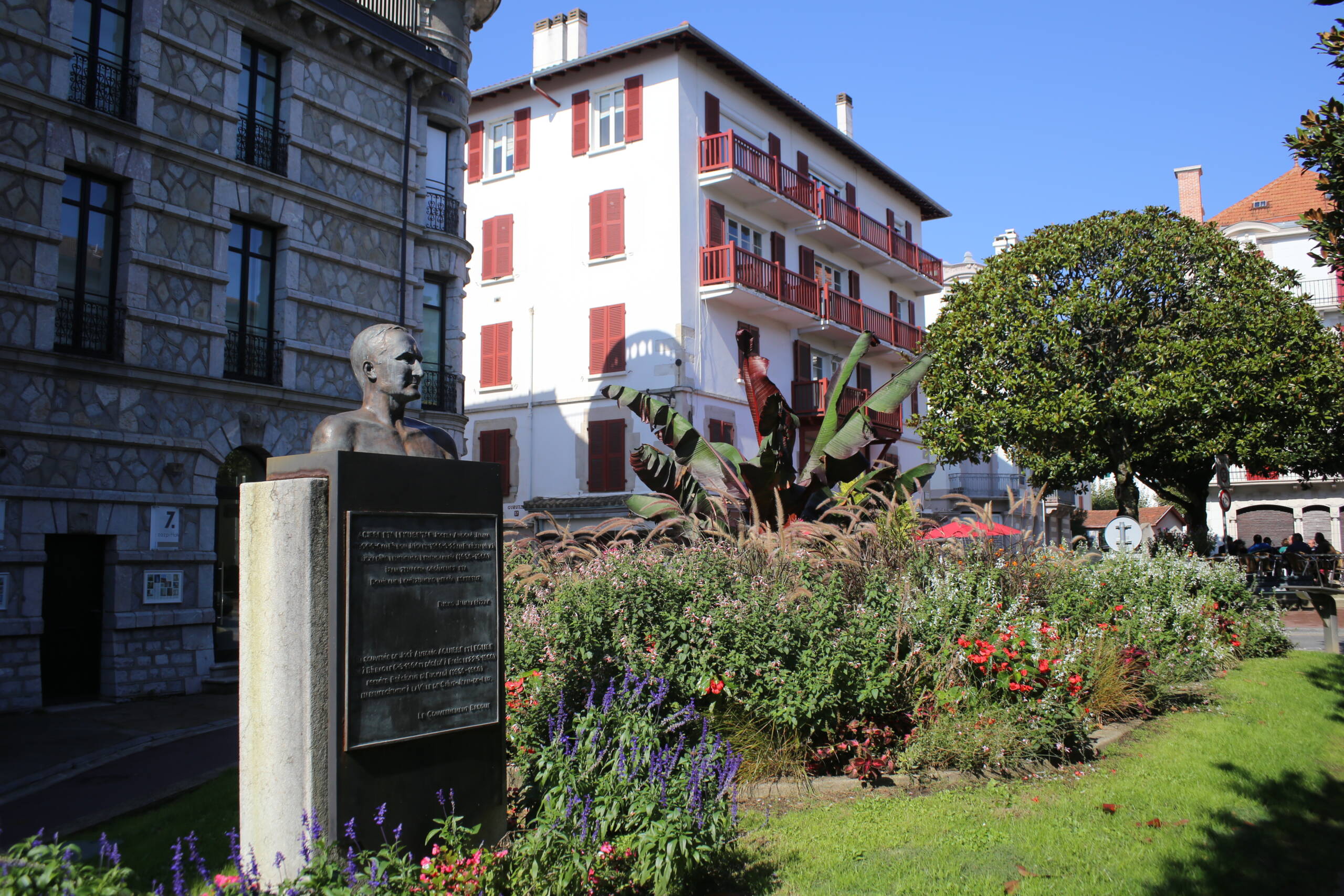
This is Hendaye, France’s southwestern edge, where the Bidasoa River meets the Atlantic and quietly doubles as a border with Spain. Geography does most of the explaining here. Hendaye is a seaside town, a border town, and a daily-life town all at once. The river is not a barrier so much as a shared space, linking Hendaye to Hondarribia and Irun just across the water. Trains, bicycles, walkers, and café chatter move back and forth with ease. The town itself spreads gently between its long beach, its compact centre, and the low hills behind, making it possible to move from ocean air to shaded streets in minutes, without feeling like you’ve changed places entirely.
The deeper context is the Basque Country, a cultural region older and more resilient than the political borders that cut through it. Hendaye lies in the northern Basque Country, where Basque identity expresses itself quietly but confidently: in architecture, in food, in festivals, and in the continued presence of the Basque language alongside French. White walls and red shutters are not decorative clichés here; they are signals of continuity. Life feels bilingual not just linguistically, but culturally, shaped by the Atlantic, the Pyrenees, and centuries of cross-border exchange. The result is a rhythm that feels grounded rather than performative, proudly local without ever turning inward.
The monument at the heart of the square represents Antoine d’Abbadie, a figure who embodies that layered identity almost too perfectly. Born in the early nineteenth century to an Irish-French family, d’Abbadie became an explorer, geographer, linguist, ethnologist, and astronomer. He spent years traveling and conducting research in East Africa, particularly in what is now Ethiopia, at a time when exploration and science were inseparably entangled. Yet despite his global reach, Hendaye was not a footnote in his life. He settled here, became deeply involved in local affairs, served as mayor, and devoted considerable energy to the promotion and preservation of Basque language and culture. For him, curiosity did not require abandoning roots; it seemed to sharpen them.
That balance is reflected in how the monument exists within the town. It doesn’t dominate the square or demand reverence. People pass by, sit nearby, drink coffee under the trees. The flowers are allowed to grow a little wild, softening the edges of memory. This isn’t a heroic statue set apart from daily life; it’s a reminder folded into it. A few minutes away, on the cliffs above the Atlantic, d’Abbadie’s former residence and observatory still stands, eccentric and imaginative, overlooking the sea he loved and studied. Together, the quiet square and the dramatic coastline form a kind of conversation between inward reflection and outward exploration.
Hendaye reveals itself in moments like this. Not through grand landmarks or forced narratives, but through places where history, geography, and ordinary life overlap without friction. Standing here, it becomes clear that travel doesn’t always announce itself with spectacle. Sometimes it appears as a pause between café tables, a bronze profile catching the light, red shutters framing an open window, and the subtle sense that borders, like gardens, can be places of growth rather than division.
Leave a Reply